
A 143 approved plot in Dineshpur Rudrapur is a plot of land that has been officially converted from agricultural to residential (non-agricultural/abadi) use under Section 143 of the UP Zamindari Abolition & Land Reforms Act, 1950 (as applicable in Uttarakhand), through a declaration issued by the Sub-Divisional Magistrate (SDM). In simple terms, it is legally cleared land on which you can build a house, register the property in your name without agricultural land restrictions, and apply for a home loan. In 2026, 143 approved plots in Dineshpur Rudrapur typically sell between ₹8,000 and ₹18,000 per sq. yard depending on location, road width, and development level.
If you are planning to buy a plot in Dineshpur — one of Rudrapur’s fastest-growing residential corridors on the Rudrapur–Dineshpur road — this guide covers everything: what 143 approval actually means, how it differs from RERA approval, current price trends, documents to verify, stamp duty, risks, and a step-by-step buying process based on our on-ground experience in the Udham Singh Nagar property market.
What Is a 143 Approved Plot in Rudrapur? (Meaning Explained)
“143 approval” refers to a land-use conversion order under Section 143 of the UPZA & LR Act, 1950, which Uttarakhand inherited from Uttar Pradesh. When the SDM issues a Section 143 declaration, the land officially ceases to be agricultural and is recorded as non-agricultural (abadi/residential) land in the revenue records.
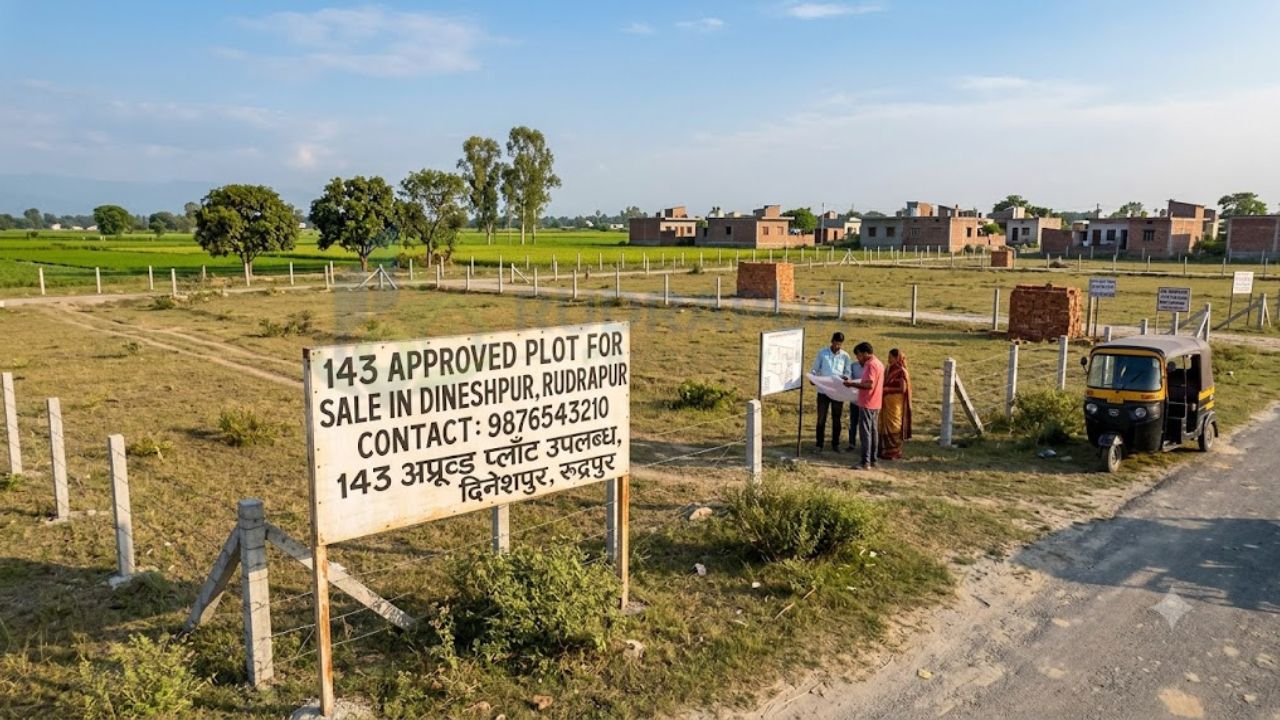
Here is what actually happens during 143 conversion:
- The landowner (usually a developer or farmer) applies to the SDM/Tehsildar for a declaration that the land is no longer used for agriculture.
- The revenue department (Tehsil Rudrapur, in Dineshpur’s case) verifies the land on-site — checking that it is genuinely being used or intended for residential purposes.
- The SDM issues a Section 143 declaration order, and the land classification changes in the khatauni (record of rights).
- The updated status is reflected in Uttarakhand’s online land records portal, Bhulekh Uttarakhand, where any buyer can verify it.
Why does this matter in Dineshpur Rudrapur specifically?
Dineshpur is a nagar panchayat area about 12–14 km from Rudrapur city, surrounded by fertile agricultural belts of Udham Singh Nagar. Because most land here was historically farmland, a large share of plots offered for sale are still agricultural in the records — even if a colony has been carved out on the ground. Without 143 conversion:
- Agricultural land purchase restrictions under Uttarakhand’s land laws can apply (especially for buyers from outside Uttarakhand, where purchase limits on agricultural land exist).
- You cannot legally obtain a residential building sanction.
- Banks will generally refuse home loans and plot loans.
- Future resale becomes harder and slower.
A 143 approved plot removes all of these hurdles — which is why “143 approved” has become the single most-asked question in the Dineshpur and Rudrapur plot market.
Local insight: In our day-to-day dealings across Dineshpur, Lalpur, Kichha Road, and Bilaspur Road, we see a consistent price premium of 25–40% for 143 approved plots over unconverted agricultural plots of the same size and location. Buyers in 2026 are far more documentation-aware than even three years ago, and unapproved plots increasingly sit unsold.
Benefits of 143 Approved Plots in Rudrapur
The main benefits of a 143 approved plot are clear legal title for residential use, eligibility for bank home loans, permission to construct, easier registration, higher resale value, and protection from agricultural land ceiling/purchase restrictions.
1. Legal right to build a house
Once land is declared non-agricultural under Section 143, you can apply for building plan approval from the local authority (nagar panchayat Dineshpur / district development authority, as applicable). On agricultural land, residential construction is technically unauthorized and can face demolition or regularization penalties.
2. Home loan and plot loan eligibility
Banks and NBFCs in Rudrapur — SBI, PNB, HDFC, LIC HFL and others — require proof of non-agricultural status before financing a plot or construction. A 143 order plus updated khatauni is exactly that proof. If you need help with financing paperwork, our home loan assistance in Rudrapur team coordinates directly with local bank branches.
3. Clean, faster registry
Sub-registrar offices process residential plot registries smoothly when the land use matches the sale deed. Mismatched land use (selling “residential plots” on agricultural khatauni) is a common cause of registry objections and future litigation.
4. Freedom from agricultural purchase restrictions
Uttarakhand restricts agricultural land purchases by non-agriculturists and non-domicile buyers (limits have been tightened further through recent state amendments). 143 converted land is outside these restrictions, which is why it is the preferred route for buyers relocating to Rudrapur from Delhi NCR, Bareilly, and the hills.
5. Better appreciation and resale liquidity
A plot that any buyer can finance and build on immediately has a much larger buyer pool. In Dineshpur, 143 approved plots have appreciated roughly 10–14% annually over 2023–2026, versus 5–8% for unconverted land.
6. Utility connections
Permanent electricity (UPCL), water, and sewer connections for residential use are straightforward on converted land.
143 Approved vs RERA Approved vs Non-Approved Plots in Rudrapur
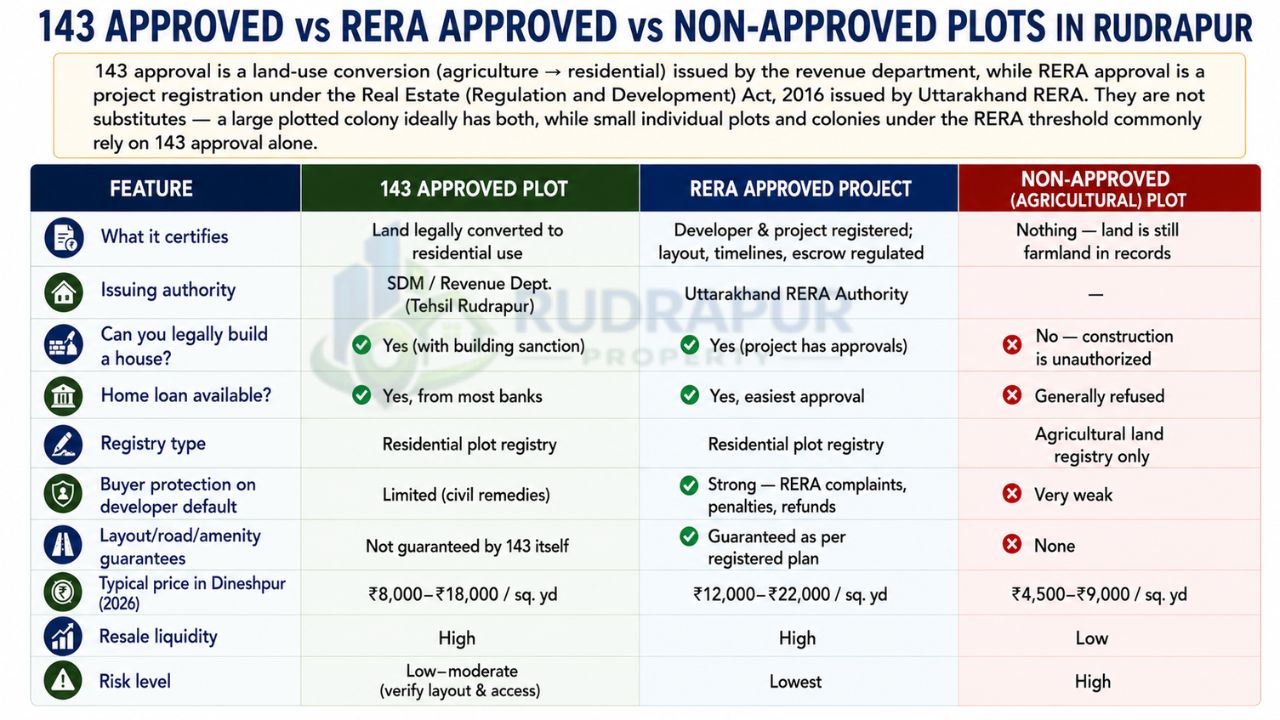
143 approval is a land-use conversion (agriculture → residential) issued by the revenue department, while RERA approval is a project registration under the Real Estate (Regulation and Development) Act, 2016 issued by Uttarakhand RERA. They are not substitutes — a large plotted colony ideally has both, while small individual plots and colonies under the RERA threshold commonly rely on 143 approval alone.
This is the most misunderstood topic among Rudrapur plot buyers, so here is a full comparison:
| Feature | 143 Approved Plot | RERA Approved Project | Non-Approved (Agricultural) Plot |
| What it certifies | Land legally converted to residential use | Developer & project registered; layout, timelines, escrow regulated | Nothing — land is still farmland in records |
| Issuing authority | SDM / Revenue Dept. (Tehsil Rudrapur) | Uttarakhand RERA Authority | — |
| Can you legally build a house? | ✅ Yes (with building sanction) | ✅ Yes (project has approvals) | ❌ No — construction is unauthorized |
| Home loan available? | ✅ Yes, from most banks | ✅ Yes, easiest approval | ❌ Generally refused |
| Registry type | Residential plot registry | Residential plot registry | Agricultural land registry only |
| Buyer protection on developer default | Limited (civil remedies) | ✅ Strong — RERA complaints, penalties, refunds | ❌ Very weak |
| Layout/road/amenity guarantees | Not guaranteed by 143 itself | ✅ Guaranteed as per registered plan | ❌ None |
| Typical price in Dineshpur (2026) | ₹8,000–₹18,000 / sq. yd | ₹12,000–₹22,000 / sq. yd | ₹4,500–₹9,000 / sq. yd |
| Resale liquidity | High | High | Low |
| Risk level | Low–moderate (verify layout & access) | Lowest | High |
Key takeaway for Dineshpur buyers
- Small colonies and individual plots (most of Dineshpur’s market): 143 approval is the minimum non-negotiable legal standard. Many genuine local colonies fall below the RERA registration threshold (500 sq. m / 8 units), so they may legitimately have 143 approval without RERA registration.
- Larger plotted townships: Ask for both the 143 order and the RERA registration number, and verify the number on the Uttarakhand RERA portal.
- “Cheap” unconverted plots: The 30–40% discount is not a bargain — it is the market pricing in legal risk, loan ineligibility, and conversion uncertainty.
143 Approved Plot Price in Dineshpur Rudrapur (2026 Trends)
In mid-2026, 143 approved plot prices in Dineshpur Rudrapur range from about ₹8,000 per sq. yard in interior lanes to ₹18,000+ per sq. yard on the main Rudrapur–Dineshpur road, with most quality residential colonies transacting between ₹10,000 and ₹14,000 per sq. yard.
Price table: 143 approved plots in and around Dineshpur (2026)
| Location / Micro-market | Price Range (₹ per sq. yd) | Typical Plot Sizes | Buyer Profile |
| Main Rudrapur–Dineshpur road frontage | ₹14,000 – ₹18,000+ | 100–250 sq. yd | Commercial-cum-residential, investors |
| Developed colonies near Dineshpur market | ₹11,000 – ₹14,000 | 100–200 sq. yd | End-users building homes |
| New 143 approved colonies (1–2 km from main road) | ₹9,000 – ₹12,000 | 100–150 sq. yd | First-time buyers, small investors |
| Interior village-adjacent plots (143 done) | ₹8,000 – ₹10,000 | 100–300 sq. yd | Budget buyers, long-horizon investors |
| Comparison: Rudrapur city (Awas Vikas, Kichha Rd) | ₹18,000 – ₹35,000 | 100–200 sq. yd | Premium end-users |
Prices are indicative market observations for July 2026; actual rates vary by road width, corner position, facing, and colony development. Circle rates (government valuation) in Dineshpur are lower than market rates — stamp duty is payable on the higher of the two.
What is driving Dineshpur prices in 2026?
- Spillover from Rudrapur city: With Rudrapur city plots crossing ₹20,000–₹35,000/sq. yd, salaried families working in SIDCUL Rudrapur (Tata Motors, Bajaj, Nestlé, Parle belt) are shifting to Dineshpur for affordability within a 20–25 minute commute.
- Road and connectivity upgrades: Improved Rudrapur–Dineshpur road connectivity and the broader infrastructure push in Udham Singh Nagar continue to compress travel time.
- Documentation-aware demand: Post-2024 tightening of land law enforcement in Uttarakhand pushed demand sharply toward legally converted plots — 143 approved inventory absorbs first.
- Limited approved supply: Conversion takes time; genuinely 143 approved, well-located colonies are a minority of listed inventory, supporting prices.
Investment outlook (2026–2029)
- Expected appreciation: 10–14% CAGR for well-located 143 approved plots is a reasonable base case, given Rudrapur’s industrial employment base and Dineshpur’s affordability gap versus the city.
- Rental/holding economics: Plots are appreciation plays; build only if you plan to occupy or can manage rental supervision locally.
- Exit liquidity: 100–150 sq. yd approved plots are the most liquid ticket size (₹10–20 lakh range) — the deepest resale market in Dineshpur.
Browse current verified options on our residential property in Rudrapur listings page — we mark 143 status on every plot we list.
Pros and Cons of Buying a 143 Approved Plot in Dineshpur
The pros — legality, loan eligibility, and appreciation — strongly outweigh the cons for end-users and medium-term investors, provided you independently verify the 143 order, khatauni entry, and physical access before paying any token amount.
| ✅ Pros | ⚠️ Cons / Watch-outs |
| Legal residential status; construction permitted | 143 approval does NOT certify colony layout quality, road width, or drainage |
| Bank home loan & plot loan eligible | Some sellers show a 143 order for part of the khasra, not your specific plot |
| Clean residential registry; fewer future disputes | Interior Dineshpur locations still developing; amenities take time |
| 25–40% resale premium over unconverted land; larger buyer pool | Price premium means higher entry cost than agricultural plots |
| No agricultural purchase restrictions for outside buyers | Fake/expired/partial 143 claims exist in the market — verification is essential |
| Utility connections straightforward | Not a substitute for RERA protection in large projects |
How to Verify a 143 Approved Plot: Documents Checklist
To verify a 143 approved plot in Dineshpur, check five things — (1) the original SDM’s Section 143 declaration order, (2) the updated khatauni on Bhulekh Uttarakhand showing non-agricultural status, (3) that your specific khasra number is covered by the order, (4) a clear title chain of the seller, and (5) physical demarcation matching the records.
Complete document checklist (in verification order)
- Section 143 declaration order (certified copy) — issued by SDM, Rudrapur. Match the khasra/gata numbers on the order with the plot being sold to you.
- Khatauni (record of rights) — pull it yourself from Bhulekh Uttarakhand; confirm the seller’s name and the non-agricultural classification. Never rely only on the copy the seller hands you.
- Khasra map / sajra plan — confirms the plot’s exact position, shape, and access road within the khasra.
- Mother deed + title chain (last 30 years ideally, 12 minimum) — how the seller acquired the land; check for inheritance disputes if it came through family partition.
- Encumbrance / charge check — confirm no bank mortgage or court attachment; verify past registrations through the sub-registrar’s office / Uttarakhand Registration Department.
- Mutation (dakhil-kharij) records — the seller’s name must be mutated in revenue records, not just on an old sale deed.
- Layout/colony approval (if buying inside a colony) — and RERA registration number if the project size crosses the threshold; verify at rera.uk.gov.in.
- Aadhaar/PAN of seller & witnesses — for the registry; also confirm the seller in person matches the khatauni owner.
- No-dues on land revenue — small but avoids mutation friction later.
- On-site demarcation report — get a measurement done before payment. Our land survey & valuation in Rudrapur service physically verifies boundaries against the sajra so you never pay for paper measurements that don’t exist on the ground.
Practical red flags we see in Dineshpur: (a) a photocopied 143 order for a different khasra number a few plots away; (b) “143 applied, approval in 1 month” claims used to sell at approved-plot prices — pay converted prices only for converted land; (c) plots carved smaller than what the sajra supports, eating into the access road.
Stamp Duty, Registration & Costs for 143 Approved Plots
On a 143 approved residential plot in Dineshpur, expect stamp duty of 5% for male buyers and a concessional rate (typically 3.75% up to prescribed value limits) for female buyers, plus registration fee of 2% (capped as per state rules), calculated on the higher of the sale price or the circle rate.
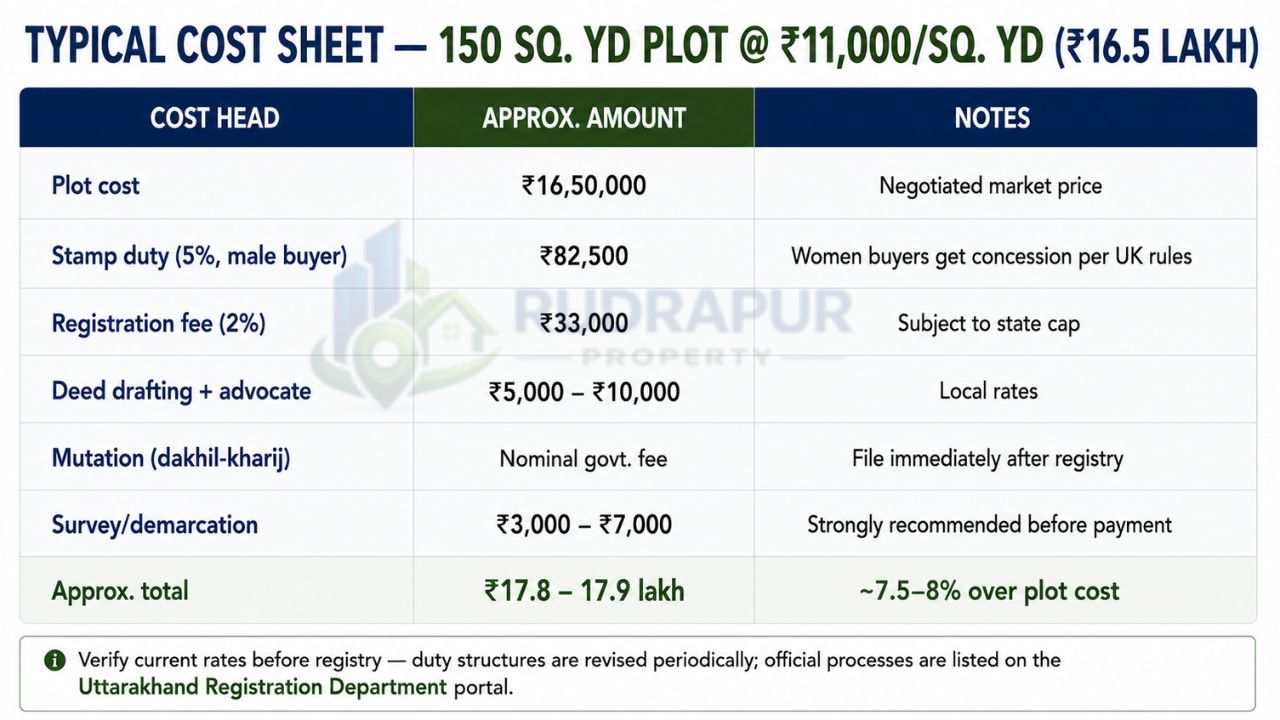
Typical cost sheet — 150 sq. yd plot @ ₹11,000/sq. yd (₹16.5 lakh)
| Cost Head | Approx. Amount | Notes |
| Plot cost | ₹16,50,000 | Negotiated market price |
| Stamp duty (5%, male buyer) | ₹82,500 | Women buyers get concession per UK rules |
| Registration fee (2%) | ₹33,000 | Subject to state cap |
| Deed drafting + advocate | ₹5,000 – ₹10,000 | Local rates |
| Mutation (dakhil-kharij) | Nominal govt. fee | File immediately after registry |
| Survey/demarcation | ₹3,000 – ₹7,000 | Strongly recommended before payment |
| Approx. total | ₹17.8 – 17.9 lakh | ~7.5–8% over plot cost |
Verify current rates before registry — duty structures are revised periodically; official processes are listed on the Uttarakhand Registration Department portal.
Our property registration in Rudrapur desk handles deed drafting, e-stamping, sub-registrar appointments, and post-registry mutation end-to-end, so out-of-town buyers can complete everything in a single visit.
Step-by-Step: How to Buy a 143 Approved Plot in Rudrapur (2026 Process)
The safe buying process is — shortlist → verify 143 order & khatauni → physical survey → token with written agreement → full legal check → registry at Sub-Registrar, Rudrapur → mutation. Done correctly, it takes 2–4 weeks.
- Shortlist by micro-market, not by price alone. In Dineshpur, prioritize colonies within 1 km of the main road with 20-ft+ internal roads and existing occupied houses.
- Ask for the 143 order and khatauni upfront. A genuine seller shares these before token. Cross-check khasra numbers yourself on Bhulekh.
- Visit and physically verify. Confirm access road ownership (is the approach road part of the approved layout or someone’s private land?), drainage slope, and electricity poles nearby.
- Commission an independent survey — boundaries per sajra, actual area measurement, encroachment check.
- Pay token only against a written agreement to sell (ikrarnama) — with plot details, khasra number, price, timelines, and a refund clause if title verification fails. Keep token amounts small (₹25,000–₹1,00,000 typical locally).
- Complete legal due diligence — title chain, encumbrances, mutation status, and (for colonies) layout/RERA status.
- Arrange financing early. Banks take 7–15 days for legal + valuation on plots; a 143 order and updated khatauni speed this up dramatically.
- Execute the sale deed at the Sub-Registrar office, Rudrapur. Pay stamp duty/registration digitally; both parties plus two witnesses present with ID.
- File mutation (dakhil-kharij) immediately. Your ownership is complete in revenue records only after mutation — many buyers skip this and face problems at resale.
- Fence or demarcate the plot within days of registry. In fast-developing belts, physical possession markers matter.
Risks of 143 Approved Plots (and How to Avoid Them)
The main risks are partial/fake 143 claims, layout-level problems the 143 order doesn’t cover, access road disputes, and inherited-title complications — all avoidable through independent record verification and an on-ground survey before payment.
- Partial conversion risk: The 143 order may cover only some khasra numbers in a colony. Fix: match your plot’s khasra to the order line-by-line.
- Layout risk: 143 changes land use; it doesn’t guarantee 30-ft roads, parks, or drainage shown in the brochure. Fix: prefer colonies with sanctioned layouts or RERA registration.
- Access dispute risk: If the approach road is on unconverted private land, you can be landlocked. Fix: verify road khasra ownership in records.
- Title/inheritance risk: Land from family partition may have unlisted heirs. Fix: 30-year title chain plus a local advocate’s opinion.
- Overpaying interior plots: 143 approval alone doesn’t justify main-road pricing 2 km inside. Fix: benchmark against the price table above and recent registries.
For land-policy updates affecting conversions and purchase limits, track official channels — the Uttarakhand Revenue Department and district administration notices for Udham Singh Nagar.
Why Dineshpur Is Worth a Serious Look in 2026
Dineshpur offers the best affordability-to-connectivity ratio in the Rudrapur belt right now — approved-plot prices at roughly half of Rudrapur city rates, a 20–25 minute commute to SIDCUL, and an established local market, schools, and healthcare of its own.
- Employment anchor: Rudrapur’s SIDCUL industrial area hosts 300+ units; housing demand from its workforce flows outward to affordable, legal plotting corridors like Dineshpur. State industrial policy continues to support the belt (see Invest Uttarakhand).
- Self-sufficient town: Dineshpur is not a bare “future colony” pitch — it has its own mandi, schools, banks, and healthcare, supporting genuine end-user demand.
- Legal-first market shift: As enforcement tightens statewide, money is rotating out of grey unconverted land into 143 approved inventory.
- Ticket size advantage: ₹10–20 lakh buys a buildable, financeable, legally clean plot — the segment with the widest resale demand in Udham Singh Nagar.
Conclusion: The Bottom Line for Buyers
A 143 approved plot in Dineshpur Rudrapur is the entry standard for safe plot buying in this market — it makes your land legally residential, financeable, and buildable. It is not the same as RERA approval, and it doesn’t replace layout-level due diligence, but combined with a verified khatauni, clean title chain, and physical survey, it is the foundation of a sound purchase. With 2026 prices between ₹8,000–₹18,000 per sq. yard and double-digit annual appreciation in good colonies, Dineshpur remains one of the most rational plot investments in the Rudrapur region — if you buy verified.
5. FAQ Section
Q1. What is a 143 approved plot in Rudrapur?
A 143 approved plot is land converted from agricultural to non-agricultural (residential) use under Section 143 of the UP Zamindari Abolition & Land Reforms Act, 1950 (applicable in Uttarakhand). The SDM issues a declaration order and the land’s classification changes in the khatauni. Only after this conversion can you legally build a house, get a residential registry, and obtain a bank home loan on the plot.
Q2. Is a 143 approved plot safe to buy in Dineshpur Rudrapur?
Yes — provided you verify the original SDM’s 143 order, confirm your exact khasra number is covered, check the updated non-agricultural status on Bhulekh Uttarakhand, verify the seller’s title chain and mutation, and get a physical survey done. Most problems come from partial conversions, access road issues, or title defects — all detectable through proper verification.
Q3. What is the price of 143 approved plots in Dineshpur Rudrapur in 2026?
As of mid-2026, 143 approved plots in Dineshpur range from about ₹8,000 per sq. yard in interior areas to ₹18,000+ on the main Rudrapur–Dineshpur road, with most quality colonies transacting between ₹10,000 and ₹14,000 per sq. yard. A typical 150 sq. yard plot costs ₹12–21 lakh, plus roughly 7.5–8% for stamp duty, registration, and incidentals.
Q4. What is the difference between 143 approved and RERA approved plots?
143 approval is a land-use conversion (agriculture to residential) issued by the revenue department for the land itself. RERA approval is a project registration under the RERA Act, 2016, regulating the developer, layout, timelines, and buyer protections. 143 makes the land legally residential; RERA regulates the project built on it. Large plotted colonies should have both; small colonies below the RERA threshold may legitimately have only 143 approval.
Q5. Can I get a home loan on a 143 approved plot in Rudrapur?
Yes. Banks require proof that a plot is non-agricultural before lending, and the Section 143 order plus updated khatauni provides exactly that. SBI, PNB, HDFC, LIC HFL and other lenders active in Rudrapur regularly finance 143 approved plots and plot-plus-construction loans. Unconverted agricultural plots are generally refused financing.
Q6. How do I verify whether a plot is genuinely 143 approved?
Ask for a certified copy of the SDM’s Section 143 declaration order and match its khasra/gata numbers with the plot being sold. Then independently pull the khatauni from bhulekh.uk.gov.in and confirm the non-agricultural classification and seller’s name. Finally, verify the plot’s position on the khasra map (sajra) and get an on-ground demarcation survey. Never rely solely on seller-provided photocopies.
Q7. Can I build a house immediately on a 143 approved plot in Dineshpur?
Yes, subject to building plan sanction from the local authority. Because the land is already classified residential, plan approval is a routine process. On unconverted agricultural land, any residential construction is unauthorized and carries demolition or penalty risk.
Q8. What is the stamp duty on a 143 approved plot in Rudrapur?
Stamp duty in Uttarakhand is typically 5% for male buyers, with a concessional rate (around 3.75%, subject to value limits) for female buyers, plus a registration fee of 2% subject to state caps — calculated on the higher of the transaction value or circle rate. Confirm current rates at the Sub-Registrar office before registry, as they are revised periodically.
Q9. Are 143 approved plots in Dineshpur a good investment in 2026?
For medium-term investors (3–5+ years) and end-users, yes. Dineshpur’s 143 approved plots have shown roughly 10–14% annual appreciation, driven by spillover demand from Rudrapur city (where prices are ~2x higher), SIDCUL employment, and the market-wide shift toward legally clean inventory. The ₹10–20 lakh ticket size is also the most liquid resale segment in Udham Singh Nagar.
Q10. Can buyers from outside Uttarakhand purchase a 143 approved plot in Rudrapur?
Yes. Uttarakhand’s land purchase restrictions primarily target agricultural land purchases by non-domicile buyers. Since a 143 approved plot is classified non-agricultural, these limits generally do not apply — making 143 approved plots the standard legal route for buyers from Delhi NCR, UP, and other states.