
Property registration is the final and most crucial legal step that officially transfers ownership rights in India. Many buyers mistakenly believe that signing the agreement to sell or paying the seller completes the transaction, but the property is only legally secured after registration. This complete guide to property registration process in India walks you through every aspect—from preparation and stamp duty to the sub-registrar office visit and post-registration steps—helping home buyers, investors, NRIs, and families avoid costly legal mistakes.
Why Property Registration Is Important?
Registration under the Registration Act, 1908, is not merely a formality but a legal necessity. It serves several critical purposes:
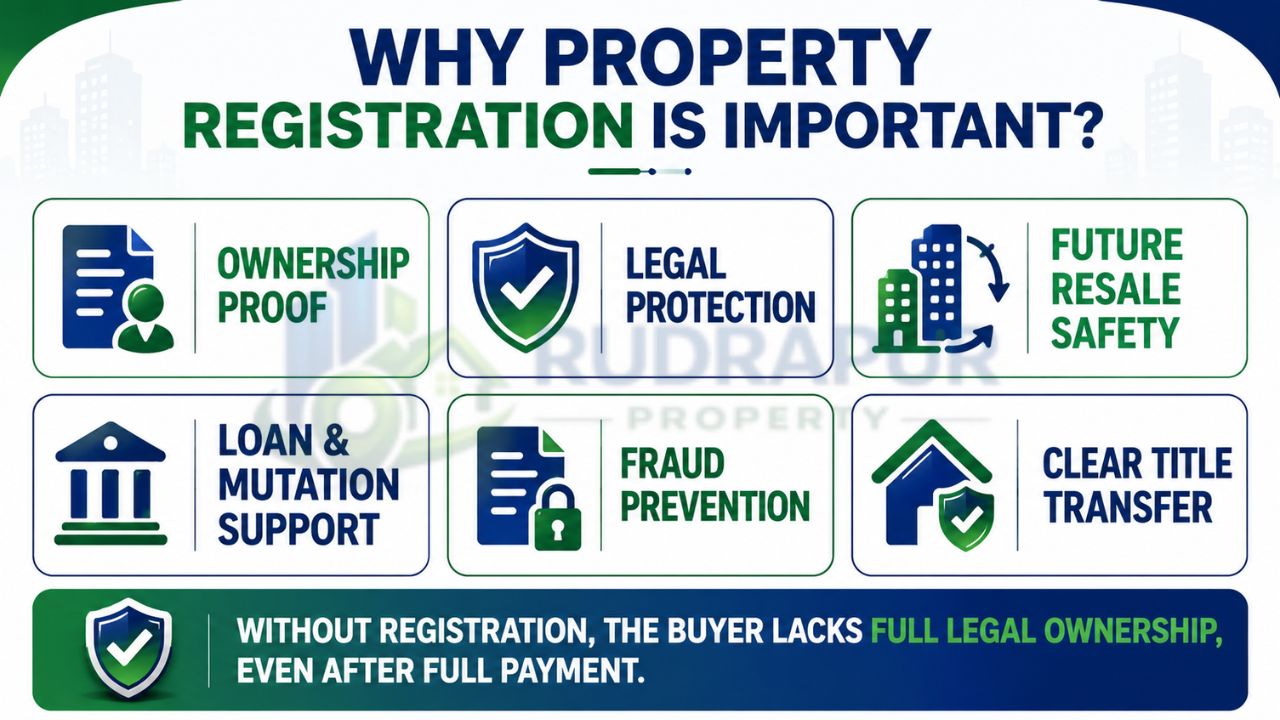
- Ownership Proof: Creates an official public record of the transfer.
- Legal Protection: Prevents future disputes and strengthens your claim in court.
- Future Resale Safety: A registered sale deed simplifies subsequent transactions.
- Loan and Mutation Support: Banks require it for home loans; it enables mutation in revenue records.
- Fraud Prevention: Government verification reduces risks of forged documents or multiple sales.
- Clear Title Transfer: Ensures the property is free from encumbrances and properly documented.
Without registration, the buyer lacks full legal ownership, even after full payment.
What Is Property Registration?
Property registration is the process of recording the transfer of immovable property rights with the government through the sub-registrar’s office. It involves executing and registering a sale deed (or conveyance deed), paying applicable stamp duty and fees, and obtaining an official endorsement. This creates a permanent legal record, making the transaction binding and transparent.
In 2026, many states have introduced digital enhancements, online portals, biometric verification, and even paperless options in select regions, making the process more efficient while maintaining core safeguards.
Step-by-Step Property Registration Process
The property registration process in India follows a structured flow. Here is the complete sequence:
- Verify Property Ownership and Title: Conduct thorough due diligence. Check the title deed chain (30+ years ideally), encumbrance certificate (EC), and ensure no liens or disputes exist.
- Confirm All Property Documents: Gather approved building plans, occupancy/completion certificates (for constructed properties), property tax receipts, and NOCs if required.
- Check Outstanding Dues: Clear all property taxes, utility bills, society dues, and maintenance charges.
- Calculate Stamp Duty and Registration Fees: Determine costs based on circle rate or transaction value (whichever is higher). Pay via authorized banks or online portals.
- Draft the Sale Deed: Prepare the deed with accurate details of parties, property description, price, payment terms, and clauses. Have a lawyer review it.
- Print on Stamp Paper: Execute the deed on appropriate non-judicial stamp paper or e-stamp as per state rules.
- Book Appointment and Visit Sub-Registrar Office: Schedule a slot (mandatory in many states) and attend with all parties.
- Submit Documents and ID Proofs: Present originals and copies.
- Complete Biometric and Witness Verification: Undergo fingerprint/Aadhaar-based verification; witnesses sign.
- Pay Remaining Charges: If not paid online.
- Get the Deed Registered: The sub-registrar reviews, endorses, and registers the document.
- Collect Registered Sale Deed: Usually available shortly after or within days/weeks.
Digital initiatives in 2026 allow online document uploads and payments in several states, reducing physical visits.
Documents Required for Property Registration
A clear checklist helps avoid last-minute issues:
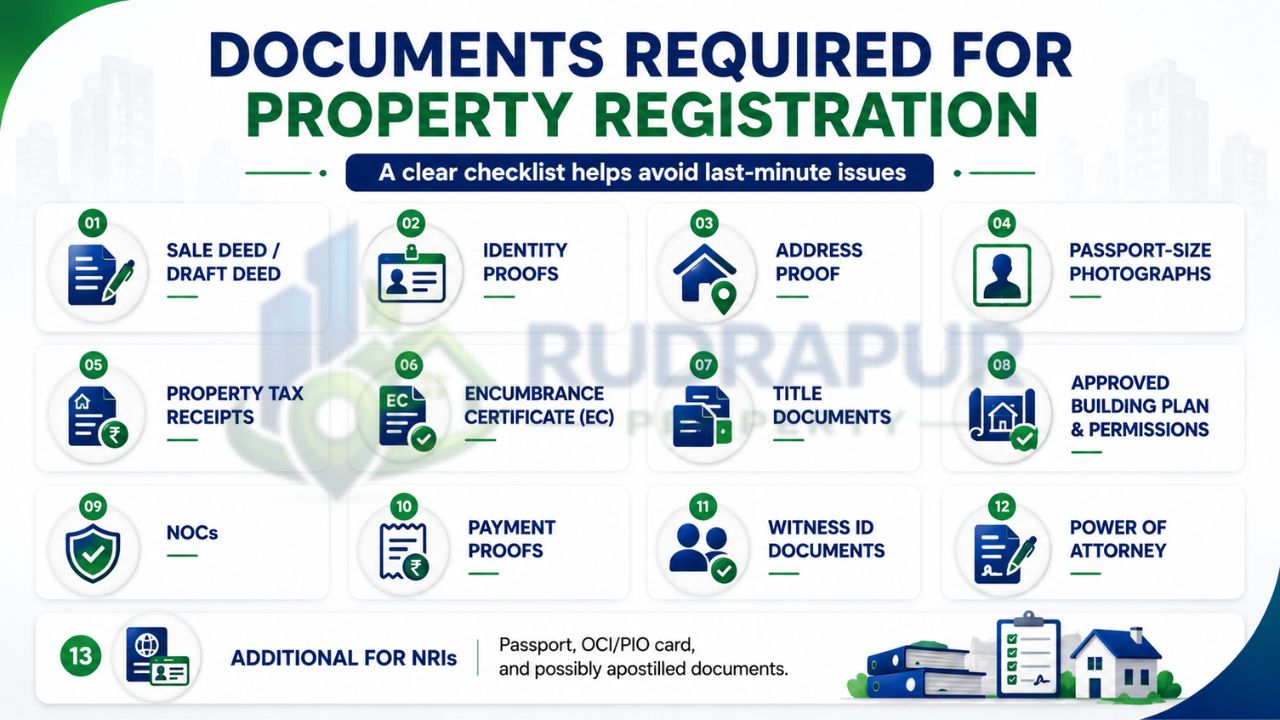
- Sale Deed / Draft Deed: Properly executed on stamp paper.
- Identity Proofs: Aadhaar, PAN, Passport, Voter ID, or Driving License for buyer and seller.
- Address Proof: Aadhaar, utility bills, or bank statements.
- Passport-size Photographs: Of buyer, seller, and witnesses.
- Property Tax Receipts: Latest paid receipts.
- Encumbrance Certificate (EC): Recent, covering adequate years.
- Title Documents: Previous deeds, mutation records/Khata.
- Approved Building Plan and Permissions: From local authorities.
- NOCs: From society, bank (if loan), or other authorities.
- Payment Proofs: Stamp duty and registration fee receipts.
- Witness ID Documents: Two witnesses required.
- Power of Attorney: If applicable, duly registered.
- Additional for NRIs: Passport, OCI/PIO card, and possibly apostilled documents.
Carry originals and multiple photocopies. In 2026, Aadhaar-linked digital verification is increasingly mandatory.
How Stamp Duty and Registration Charges Work?
Stamp duty is a state government tax on the property transaction, calculated on the higher of the agreement value or circle rate (government-assessed minimum value). Registration fee is usually 1% (varies by state).
Key points:
- Rates typically range from 3-7% for stamp duty, with concessions for women buyers or first-time owners in many states.
- Examples (2026 approximate): Delhi (4-6%), Maharashtra (5-7% + cess), Karnataka (2-5% +1%), Uttar Pradesh (6-7%). Always check the latest state-specific rates.
- Additional charges may include transfer duty or metro cess.
- Pay online or through authorized channels before or at registration.
Underpayment can lead to penalties, notices, or registration refusal. Use official calculators on state registration portals.
Role of the Sub-Registrar Office
The sub-registrar’s office is the authorized government body for registration. What happens there:
- Document scrutiny for completeness and compliance.
- Identity verification of all parties via biometrics and Aadhaar.
- Presence of buyer, seller, and two witnesses.
- Reading or explanation of the deed.
- Signatures and thumb impressions.
- Official endorsement and registration in records.
In 2026, processes are more streamlined with online appointments, video recording in some states, and digital signatures. The entire process at the office can take 1-3 hours if documents are in order.
Importance of Mutation After Registration
Registration transfers legal title, but mutation after property registration updates the buyer’s name in revenue (land records) and municipal records. This is essential for:
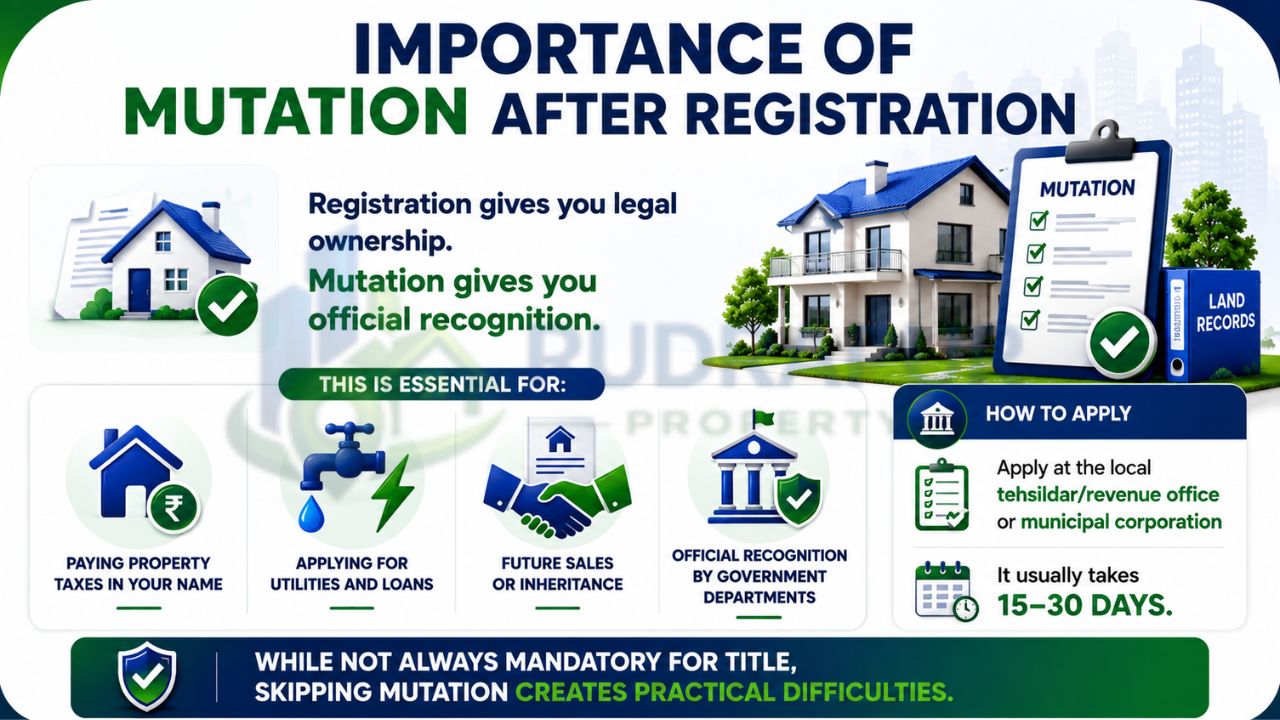
- Paying property taxes in your name.
- Applying for utilities and loans.
- Future sales or inheritance.
- Official recognition by government departments.
Apply at the local tehsildar/revenue office or municipal corporation with the registered sale deed, ID proofs, and application form. It usually takes 15-30 days. While not always mandatory for title, skipping it creates practical difficulties.
Common Mistakes to Avoid
- Not verifying title or EC before proceeding to registration.
- Miscalculating or underpaying stamp duty.
- Incomplete or inaccurate sale deed (wrong names, boundaries, or clauses).
- Missing required IDs, witnesses, or NOCs.
- Skipping physical site verification or dues clearance.
- Delaying mutation after registration.
- Relying on verbal assurances instead of written documents.
Tips for a Smooth Registration Process
- Engage a qualified lawyer for deed drafting and verification.
- Prepare all documents well in advance and verify details (names, dates, measurements).
- Book sub-registrar appointment online where available.
- Confirm circle rate and pay duties promptly.
- Carry extra photocopies and payment proofs.
- Review every clause in the deed carefully before signing.
- For NRIs, use authorized representatives with proper POA.
- Opt for digital processes where offered for speed and transparency.
Conclusion
The complete guide to property registration process in India highlights that registration is the definitive legal step securing your ownership. By understanding how to register property in India, preparing documents required for registration, calculating stamp duty and registration charges accurately, navigating the sub-registrar office process, and completing mutation after property registration, buyers can confidently protect their investment and avoid disputes. Always consult professionals and use official government portals for the latest updates, as procedures can vary slightly by state. With proper diligence, your property journey will be safe, transparent, and successful.
FAQs
What is the property registration process in India?
It involves title verification, deed preparation on stamp paper, payment of duties, and formal registration at the sub-registrar’s office, followed by mutation.
What documents are required for property registration?
Sale deed, ID/address proofs (Aadhaar, PAN), EC, tax receipts, approved plans, NOCs, photographs, and witness documents.
How is stamp duty calculated?
Based on the higher of agreement value or circle rate, at state-specific percentages (typically 4-7%), with possible gender-based concessions.
What happens at the sub-registrar office?
Document verification, biometric checks, witness presence, deed signing, and official registration by the sub-registrar.
Is mutation necessary after registration?
Highly recommended (though not always legally mandatory) to update revenue and municipal records in the buyer’s name for practical ownership benefits.
Can property be legally owned without registration?
No. An unregistered agreement does not transfer legal title; registration is mandatory for most property transfers.
How long does property registration take in India?
Preparation can take weeks; the office process takes hours if documents are ready. Collection of the registered deed may take a few days to weeks.