
Buying property in Rudrapur in 2026 involves seven core stages: budget planning, area selection, RERA and title verification, home loan approval, agreement execution, stamp duty payment and registration, and post-purchase mutation. Following this sequence in order — and never skipping legal due diligence — is the single biggest factor that separates a safe purchase from a costly mistake.
Rudrapur has grown from an industrial town in the Udham Singh Nagar district into one of Uttarakhand’s fastest-expanding real estate markets. With the Kashipur Road corridor, Pantnagar’s industrial belt, and new residential townships pulling in both local buyers and outstation investors, demand for clear, dependable buying guidance has never been higher. This guide walks you through the entire how to buy property in Rudrapur process — from your first budget conversation to the day the property is legally mutated in your name.
Whether you’re a first-time homebuyer, an NRI investor, or someone relocating for work near Pantnagar or the industrial estate, this buy property in Rudrapur guide 2026 is built to answer every question you’ll face along the way.
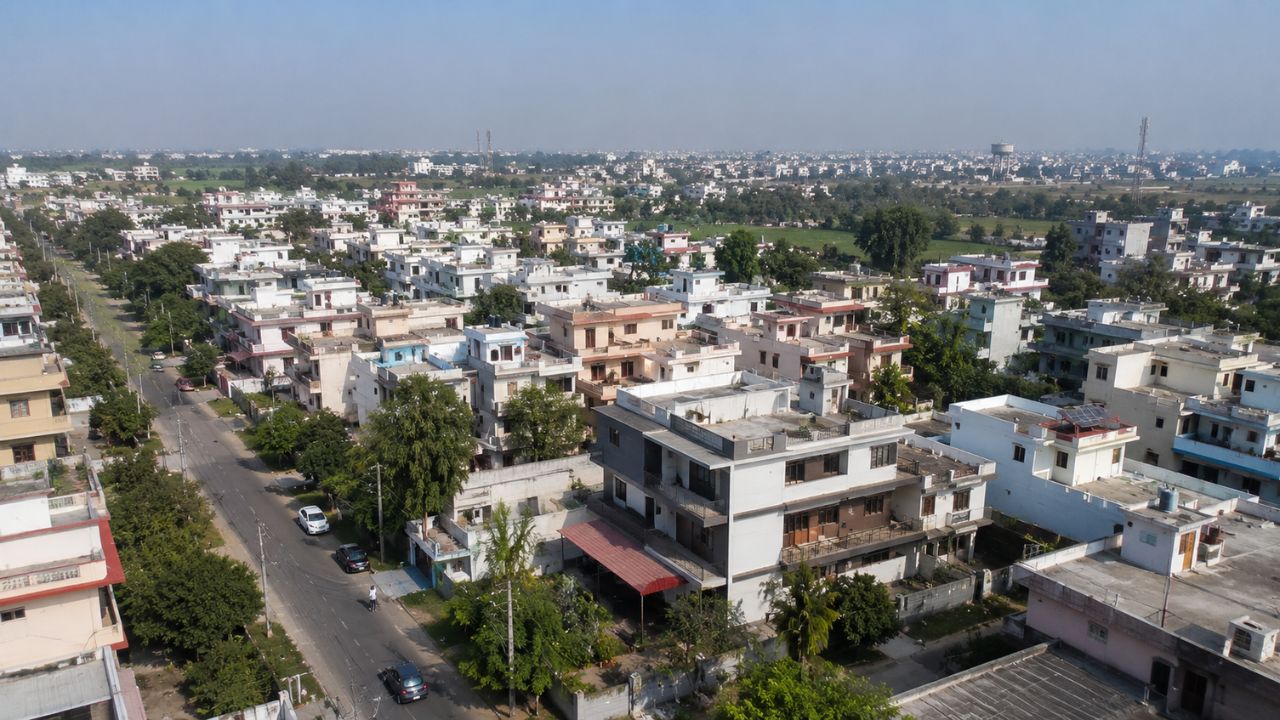
Why Rudrapur Is Attracting Property Buyers in 2026
Rudrapur’s appeal isn’t accidental. A few structural factors are driving demand:
- Industrial employment base — Pantnagar’s industrial estate (Tata Motors, Nestlé, Parle, and dozens of ancillary units) creates steady rental and end-user demand.
- Improving connectivity — Highway upgrades along the Kashipur–Rudrapur–Haldwani belt are shortening commute times to nearby cities.
- Affordable entry price compared to Dehradun or Haldwani — Per-square-foot rates in Rudrapur remain lower than in Uttarakhand’s more saturated markets, leaving room for appreciation.
- Expanding residential supply — New plotted developments and independent floors are being launched across Transport Nagar, Kashipur Road, and the outer ring areas.
Best time to buy property in Rudrapur 2026: Market activity typically slows during the monsoon months (July–September) when site visits are harder and construction pauses, which gives buyers more negotiating leverage. Conversely, the post-monsoon and pre-financial-year-end window (October to March) sees the highest transaction volume, better inventory choice, and more competitive pricing on ready-to-move units — making it the practical window to both negotiate hard and get faster registration slot availability at the sub-registrar office.
Step-by-Step Property Buying Process in Rudrapur (Overview Table)
| Step | Stage | What Happens | Typical Timeframe |
| 1 | Budget & Loan Pre-Approval | Assess affordability, get in-principle loan sanction | 3–7 days |
| 2 | Area & Property Shortlisting | Compare localities, visit sites | 1–3 weeks |
| 3 | RERA & Title Verification | Check builder/project RERA status, title chain | 3–10 days |
| 4 | Document & Legal Due Diligence | Lawyer verifies ownership, encumbrance, approvals | 7–14 days |
| 5 | Negotiation & Agreement to Sell | Price finalization, token/advance payment | 2–5 days |
| 6 | Home Loan Final Disbursement | Bank valuation, legal check, disbursement | 15–20 days |
| 7 | Stamp Duty Payment & Registration | Execute sale deed at sub-registrar office | 1–3 days |
| 8 | Mutation (Dakhil-Kharij) | Property record transferred to buyer’s name | 15–45 days |
This table is your master checklist — each stage is explained in detail below.
Step 1: Budget Planning and Financing
Before shortlisting any property, calculate your total budget as the sum of the property price, stamp duty and registration charges (typically 6–7% of property value in Uttarakhand), legal fees, brokerage (if applicable), and a contingency of 3–5% for unforeseen costs.
A realistic budget isn’t just the property’s listed price. Build it as:
- Base property cost (negotiated price)
- Stamp duty + registration fee (varies by gender of buyer and property type in Uttarakhand)
- Home loan processing fee (0.25%–1% of loan amount, bank-dependent)
- Legal and documentation charges
- Brokerage, if using an agent
- Interior, utility connection, and moving costs
Home Loan Options for Property in Rudrapur (Comparison Table)
| Loan Factor | Public Sector Banks | Private Banks | Housing Finance Companies (HFCs) |
| Interest Rate Range | Generally lower, linked to repo rate | Slightly higher, faster processing | Higher, flexible eligibility |
| Loan-to-Value (LTV) | Up to 80–90% of property value | Up to 80–90% | Up to 75–85% |
| Processing Speed | Slower, more documentation | Faster, digital-first | Fast, suited for self-employed |
| Best Suited For | Salaried applicants, long tenure | Salaried + professionals wanting speed | Self-employed, informal income proof |
| Prepayment Charges | Usually nil (floating rate) | Usually nil (floating rate) | May apply on fixed-rate loans |
Practical tip: Get your loan pre-approved (in-principle sanction) before finalizing a property. This tells sellers you’re a serious buyer and speeds up final disbursement once you’ve chosen a unit. If you need help comparing lenders and eligibility for a specific project in Rudrapur, home loan assistance in Rudrapur can walk you through bank-wise offers and paperwork.
Step 2: Choosing the Right Property Type and Area in Rudrapur
Match your property type — plot, independent house, or apartment — to your purpose (self-use vs. investment vs. rental income), and shortlist the locality based on proximity to your workplace, schools, and the industrial belt rather than price alone.
Property Types Available in Rudrapur
- Residential plots — Popular with buyers planning custom construction; strong long-term appreciation potential.
- Independent houses/floors — Suited to families wanting more space and privacy without high-rise living.
- Apartments/flats — Growing segment, especially near Transport Nagar and Kashipur Road, appealing to nuclear families and working professionals.
- Commercial and mixed-use property — Relevant for buyers targeting rental yield near market and industrial zones.
If you’re specifically evaluating ready or under-construction flats and independent homes, browsing current residential property in Rudrapur listings first will give you a realistic sense of area-wise pricing before you start site visits.
Area-Wise Pros and Cons for Buying Property in Rudrapur
| Area | Pros | Cons |
| Kashipur Road | High connectivity, commercial growth, good resale demand | Higher price per sq. ft. than outer areas |
| Transport Nagar | Established residential pockets, closer to city core | Traffic congestion during peak hours |
| Nanakmatta Road | More affordable plots, good for long-term appreciation | Fewer immediate civic amenities |
| Near Pantnagar Industrial Estate | Strong rental demand from industrial workforce | Noise/pollution near heavy industrial units |
| Outer Ring/Developing Sectors | Lower entry cost, larger plot sizes | Infrastructure (roads, sewage) still developing |
Local insight: Areas closer to the industrial estate and Kashipur Road consistently show faster resale and rental turnaround because of the steady inflow of working professionals — but they also command a price premium. If your priority is affordability and appreciation over 5–7 years, the outer developing sectors are worth serious evaluation, provided you verify the master plan/development authority approvals for that zone first.
Step 3: RERA Verification — Why It’s Non-Negotiable
Before paying any token amount, verify the project’s RERA registration number on the official Uttarakhand RERA portal to confirm the builder, land title, approved layout, and completion timeline are legally registered and monitored.
RERA (Real Estate Regulatory Authority) registration is mandatory in Uttarakhand for most residential and commercial projects above the notified size threshold. A RERA approved property buying guide Rudrapur checklist should always include:
- Confirming the project’s RERA registration number is active (not expired or revoked)
- Cross-checking the promoter’s name matches your agreement documents
- Reviewing the sanctioned layout plan against what’s actually being sold
- Checking the declared possession/completion date
- Reviewing any past complaints filed against the promoter on the RERA portal
You can verify all of this directly on the Uttarakhand RERA official portal, which lists registered projects, promoter details, and complaint history publicly.
Red flag: If a builder or seller is reluctant to share the RERA number or claims the project is “exempt” without clear documentation, treat this as a serious warning sign and consult a property lawyer before proceeding.
Step 4: Legal Due Diligence and Document Verification
Legal due diligence means verifying the seller’s title chain for at least 12–13 years, confirming there’s no encumbrance or pending litigation, and checking that all municipal/development authority approvals are in place — ideally done by a property lawyer before you pay any advance.
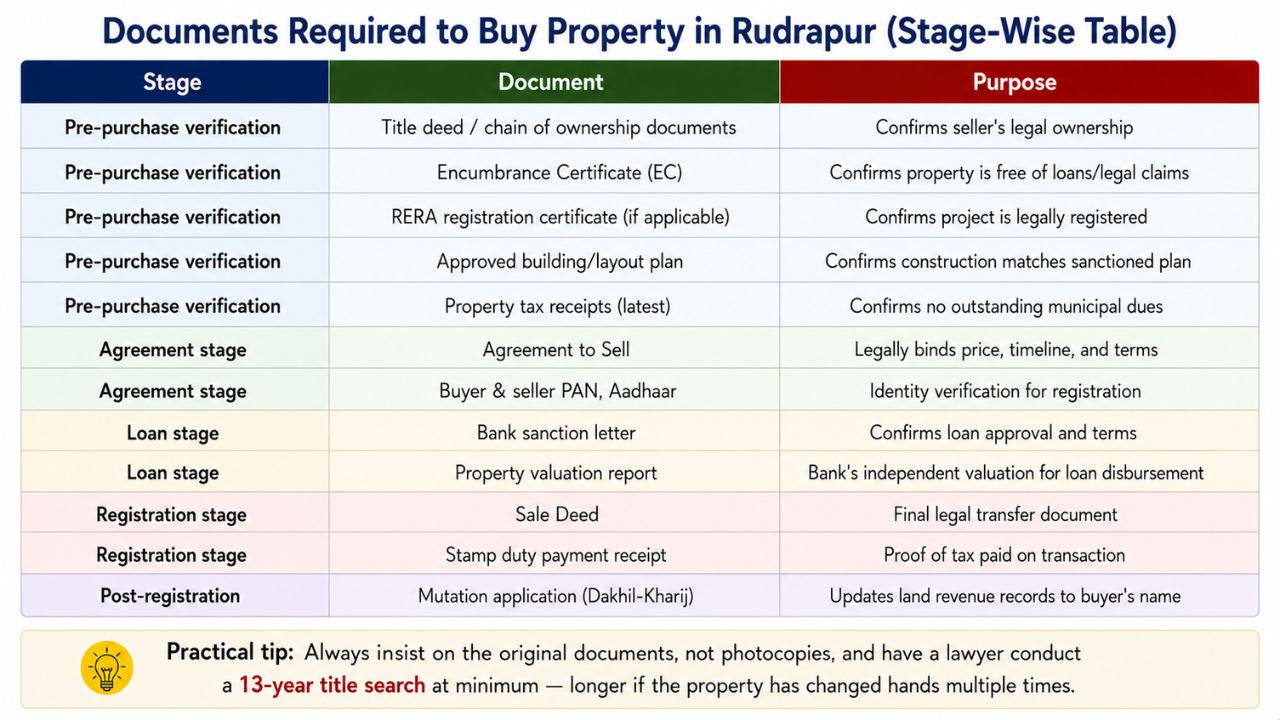
Documents Required to Buy Property in Rudrapur (Stage-Wise Table)
| Stage | Document | Purpose |
| Pre-purchase verification | Title deed / chain of ownership documents | Confirms seller’s legal ownership |
| Pre-purchase verification | Encumbrance Certificate (EC) | Confirms property is free of loans/legal claims |
| Pre-purchase verification | RERA registration certificate (if applicable) | Confirms project is legally registered |
| Pre-purchase verification | Approved building/layout plan | Confirms construction matches sanctioned plan |
| Pre-purchase verification | Property tax receipts (latest) | Confirms no outstanding municipal dues |
| Agreement stage | Agreement to Sell | Legally binds price, timeline, and terms |
| Agreement stage | Buyer & seller PAN, Aadhaar | Identity verification for registration |
| Loan stage | Bank sanction letter | Confirms loan approval and terms |
| Loan stage | Property valuation report | Bank’s independent valuation for loan disbursement |
| Registration stage | Sale Deed | Final legal transfer document |
| Registration stage | Stamp duty payment receipt | Proof of tax paid on transaction |
| Post-registration | Mutation application (Dakhil-Kharij) | Updates land revenue records to buyer’s name |
Practical tip: Always insist on the original documents, not photocopies, and have a lawyer conduct a 13-year title search at minimum — longer if the property has changed hands multiple times.
Step 5: Site Visit Checklist and Red Flags to Avoid
A proper site visit covers physical verification of boundaries, construction quality, access roads, and utility connections — and should always be done at least twice, once on a weekday and once on a weekend, to assess the neighborhood realistically.
Site Visit Checklist
- Match physical plot boundaries with the approved layout/survey map
- Check road width and access — especially for monsoon-season usability
- Verify water, electricity, and sewage connections are functional or planned
- Inspect construction quality if buying built property (cracks, seepage, flooring)
- Confirm the property isn’t in a flood-prone or low-lying zone
- Talk to neighbors about any disputes, waterlogging, or local issues
- Visit at different times of day to check noise, traffic, and safety
If you’re unsure about boundary accuracy or plot dimensions, a professional land survey & valuation in Rudrapur service can confirm exact measurements and fair market value before you finalize the deal — this is especially important for plot purchases where boundary disputes are common.
Red Flags to Avoid
- Seller pushing for cash-heavy transactions to avoid full stamp duty — this exposes you to legal and tax risk.
- Missing or inconsistent survey numbers across documents.
- Unusually low pricing compared to the area average — often signals a title or legal issue.
- No RERA number for a project that should legally have one.
- Reluctance to allow a lawyer’s review of original documents before advance payment.
Step 6: Negotiation, Agreement to Sell, and Token Payment
Once due diligence is clear, negotiate the final price, get it documented in a written Agreement to Sell with clear timelines and penalty clauses, and pay the token/advance amount only after this agreement is signed by both parties.
Key clauses your Agreement to Sell should include:
- Final agreed price and payment schedule
- Timeline for registration
- Penalty clause if either party delays or defaults
- Confirmation that the property is free from encumbrance as of the agreement date
- Handover condition (for built property) or possession terms (for plots/under-construction)
Step 7: Stamp Duty, Registration, and the Legal Process
In Uttarakhand, stamp duty is calculated as a percentage of the property’s circle rate or transaction value (whichever is higher), with registration completed at the local sub-registrar office in the presence of both buyer and seller along with two witnesses.
The legal process for property purchase in Rudrapur at the registration stage generally follows:
- Calculate stamp duty based on current Uttarakhand government rates (rates differ slightly for male, female, and joint ownership in many states, so confirm current applicable rates before payment)
- Pay stamp duty online or through the designated bank challan system
- Book a registration slot at the Rudrapur sub-registrar office
- Both parties appear with original ID proof, photographs, and the executed sale deed
- Biometric verification and document signing at the sub-registrar office
- Receive the registered sale deed copy
You can check current applicable rates and procedures on the Uttarakhand Stamp and Registration Department portal before your registration date to avoid last-minute recalculations.
Post-Registration: Mutation (Dakhil-Kharij)
Mutation updates the land revenue records to reflect you as the new owner — this is separate from registration and is often missed by first-time buyers. Apply for mutation at the local tehsil/municipal office within the prescribed period after registration, submitting the registered sale deed, ID proof, and property tax receipts. For a full walkthrough of documentation and timelines at this stage, see our dedicated guide to property registration in Rudrapur.
Common Mistakes First-Time Buyers Make in Rudrapur
- Skipping RERA verification because a broker “vouches” for the builder.
- Not budgeting for stamp duty and registration costs, leading to last-minute fund shortages.
- Relying only on verbal assurances about boundaries, approvals, or possession dates.
- Paying large advances before signing a proper Agreement to Sell.
- Ignoring the mutation step after registration, which can complicate resale or loan applications later.
- Not verifying if the land falls under any government reservation or acquisition notice.
- Choosing area based only on price, without checking connectivity and future development plans.
- Not consulting a local lawyer, assuming online document templates are sufficient for a property this valuable.
Post-Purchase Steps and Property Management
Once registration and mutation are complete:
- Update utility connections (electricity, water, gas) to your name.
- Pay property tax promptly each cycle to avoid penalty accumulation.
- Keep a physical and digital copy of all documents — sale deed, mutation certificate, tax receipts, EC.
- If renting out, draft a formal rental agreement and register it if the tenure exceeds the applicable threshold.
- Review property insurance options, especially for independent houses and built-up flats.
- Reassess valuation periodically if you plan to use the property for future loan collateral or resale.
Final Thoughts
Buying property in Rudrapur in 2026 rewards buyers who follow a disciplined process — verify RERA status, complete legal due diligence, budget accurately for stamp duty and registration, and never skip mutation after the sale deed is signed. The market’s growth, driven by the Pantnagar industrial belt and improving connectivity, makes it a genuinely promising city for both end-use and investment purchases — provided the fundamentals are checked at every stage.