
Quick answer: In Rudrapur, plots have historically delivered stronger capital appreciation, especially in developing corridors like Kichha Road, Lalpur, and areas near SIDCUL. Flats, on the other hand, generate rental income from day one and suit buyers who want a ready-to-use, low-effort asset. The “better” option depends on your investment horizon, budget, and whether you need regular income or long-term wealth growth.
This guide compares plots vs flats in Rudrapur honestly — covering appreciation, rental yield, risk, maintenance, liquidity, and which option fits which type of buyer. By the end, you should know exactly which side of this decision you belong on.
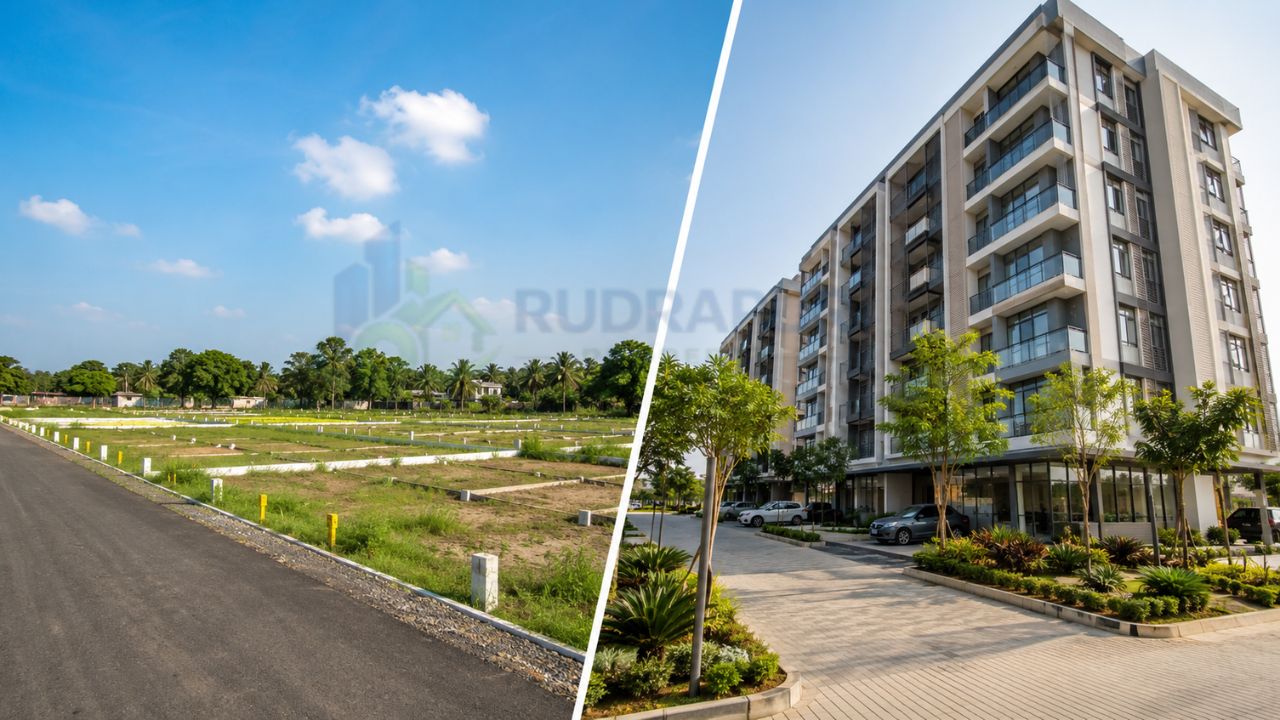
Why This Decision Matters in Rudrapur Right Now
Direct answer: Rudrapur is one of Uttarakhand’s fastest-growing industrial cities, and both land prices and apartment demand have risen steadily — but they reward very different kinds of investors.
Rudrapur’s growth story rests on three pillars:
- SIDCUL industrial area, which hosts major manufacturers and drives steady employment and migration into the city.
- Connectivity, with NH-109 and NH-87 linking Rudrapur to Haldwani, Nainital, Bareilly, and the wider Kumaon region, plus improving rail connectivity through Rudrapur City station.
- Institutional demand from Pantnagar University, hospitals, and a growing services sector, which keeps rental demand alive.
This mix creates two parallel opportunities. Land in developing pockets appreciates as the city expands outward. Meanwhile, thousands of factory employees, professionals, and students need ready homes to rent — which is where flats earn their keep.
Because the drivers are different, comparing plots vs flats — which is better investment in Rudrapur — is not about one universal winner. It is about matching the asset to your goal.
Plots vs Flats in Rudrapur: Quick Comparison Table
Direct answer: Plots win on appreciation, flexibility, and low holding costs; flats win on rental income, financing ease, and immediate usability.
| Factor | Plots in Rudrapur | Flats in Rudrapur |
| Entry price | Flexible — small plots in developing areas can cost less than a 2BHK | Fixed ticket sizes; 2BHK typically the entry point |
| Capital appreciation | Generally higher in growth corridors (historically 8–15% p.a. in good pockets) | Moderate (typically 4–7% p.a.); building depreciates while land share appreciates |
| Rental income | None (unless developed) | Immediate — typically 2.5–3.5% gross yield |
| Maintenance cost | Minimal (boundary wall, occasional cleaning) | Monthly society/maintenance charges + repairs |
| Construction freedom | Full — build what you want, when you want | None — fixed layout and structure |
| Loan availability | Land loans available but stricter terms, lower LTV | Home loans widely available, up to 80–90% LTV, lower rates |
| Tax benefits on loan | Only if you construct within the stipulated period | Section 80C + Section 24(b) benefits from possession |
| Risk profile | Title disputes, encroachment, unapproved layouts | Builder delays, quality issues, oversupply in some segments |
| Liquidity | Slower to sell, but broad buyer pool for good locations | Faster in popular societies; older flats sell slower |
| Effort required | Low while holding; high if you build | Low throughout |
Keep this table handy — the rest of this article unpacks each row with Rudrapur-specific context.
Capital Appreciation: Do Plots or Flats Grow Faster in Rudrapur?
Direct answer: Plots in Rudrapur’s expanding corridors have generally appreciated faster than flats, because land is the scarce component while built-up structures depreciate over time.
Why Plots Appreciate Faster
Rudrapur is expanding outward along Kichha Road, Bilaspur Road, and the corridors connecting to the industrial belt. When a city grows this way, land at the edge of development often re-rates sharply once roads, colonies, and commercial activity arrive.
- A plot’s value is 100% land, and land is what appreciates.
- A flat’s value is part land (a small undivided share) and part structure — and the structure depreciates with age.
- Well-located plots near SIDCUL, the proposed infrastructure upgrades, and established colonies have historically delivered stronger long-term growth than comparable flats.
Housing price data from the National Housing Bank’s RESIDEX index consistently shows that in tier-2 and tier-3 cities, land-driven markets outperform apartment resale markets over long horizons.
Where Flats Hold Their Own
Flats in well-managed societies close to SIDCUL and the city centre do appreciate — just more modestly. Their advantage is predictability: a good 2BHK in a maintained society rarely crashes in value, and demand from salaried tenants keeps prices supported.
Verdict on appreciation: For pure ROI on plots vs flats in Rudrapur over 7–15 years, plots in the right corridor usually come out ahead.
Rental Yield: Flats Earn, Plots Wait
Direct answer: Flats clearly win on rental income — a vacant plot earns nothing, while a flat near SIDCUL or the city centre can start generating rent within weeks of possession.
Rudrapur has a deep rental market because of its industrial workforce:
- 2BHK flats near SIDCUL and city-centre areas are the workhorses — steady demand from factory supervisors, engineers, and small families.
- 1BHK and studio units attract single professionals and students.
- Independent floors in colonies like Awas Vikas rent well to families wanting more space.
Gross rental yields in Rudrapur typically fall in the 2.5–3.5% range, in line with most Indian residential markets. That is not spectacular, but it is real monthly cash flow that offsets EMIs and holding costs.
A plot produces zero income while you hold it. If you build on the plot later — say, independent floors for rent — the combined return can beat a flat, but that requires additional capital, time, and effort.
Verdict on income: If monthly cash flow matters to you, flats win without contest. Explore current rental-friendly residential properties in Rudrapur to see what typical 2BHK options look like.
Advantages of Buying a Plot in Rudrapur
Direct answer: The biggest advantages of buying a plot in Rudrapur are higher appreciation potential, complete construction freedom, negligible maintenance, and a lower entry ticket in developing areas.
- Higher long-term appreciation. Land in growth corridors captures the full upside of Rudrapur’s expansion.
- Construction freedom. Build a home, independent floors, a shop-cum-residence, or simply hold. You control design, quality, timing, and budget.
- Low holding cost. No society charges, no lift maintenance, no repairs. A boundary wall and periodic upkeep are usually enough.
- No depreciation. Land does not age. A 15-year-old plot is worth more, not less, if the location has developed.
- Flexible ticket sizes. From 100 sq yd plots in developing colonies to larger parcels, you can match the investment to your budget.
- Easier to phase your investment. Buy the land now, construct in 5 years when your finances allow.
The Fine Print on Plots
Plots demand more homework. Before buying, you must verify the title chain, check whether the layout is approved by the local development authority, confirm land-use classification, and ensure the plot is not in a disputed or encroached area. Professional land survey and valuation services are worth every rupee here — boundary disputes and inflated pricing are the two most common ways plot buyers lose money.
Advantages of Buying a Flat in Rudrapur
Direct answer: The biggest advantages of buying a flat in Rudrapur are immediate usability, rental income from day one, easy home-loan financing, better security, and zero construction hassle.
- Ready to use. Move in or rent out immediately — no architect, contractor, or two-year construction project.
- Rental income. Steady tenant demand from Rudrapur’s industrial and institutional workforce.
- Easier financing. Banks readily lend up to 80–90% of a flat’s value at standard home-loan rates. The Reserve Bank of India’s guidelines on housing loan LTV ratios allow higher leverage for ready residential property than for land purchase.
- Tax efficiency. Home-loan principal (Section 80C) and interest (Section 24(b)) deductions apply from possession.
- Amenities and security. Gated societies offer parking, power backup, security, and community living — valuable for families and elderly parents.
- RERA protection. Under-construction flats in registered projects come with legal safeguards on timelines and specifications. Always verify a project’s registration on the Uttarakhand RERA portal before booking — an unregistered project is a red flag you should not ignore.
The Fine Print on Flats
Flats carry their own risks: construction delays in under-construction projects, monthly maintenance charges that rise over time, aging structures that depreciate, and potential oversupply in specific micro-markets. A flat’s resale value after 15–20 years depends heavily on how well the society is maintained.
Risk Comparison: What Can Go Wrong with Each?
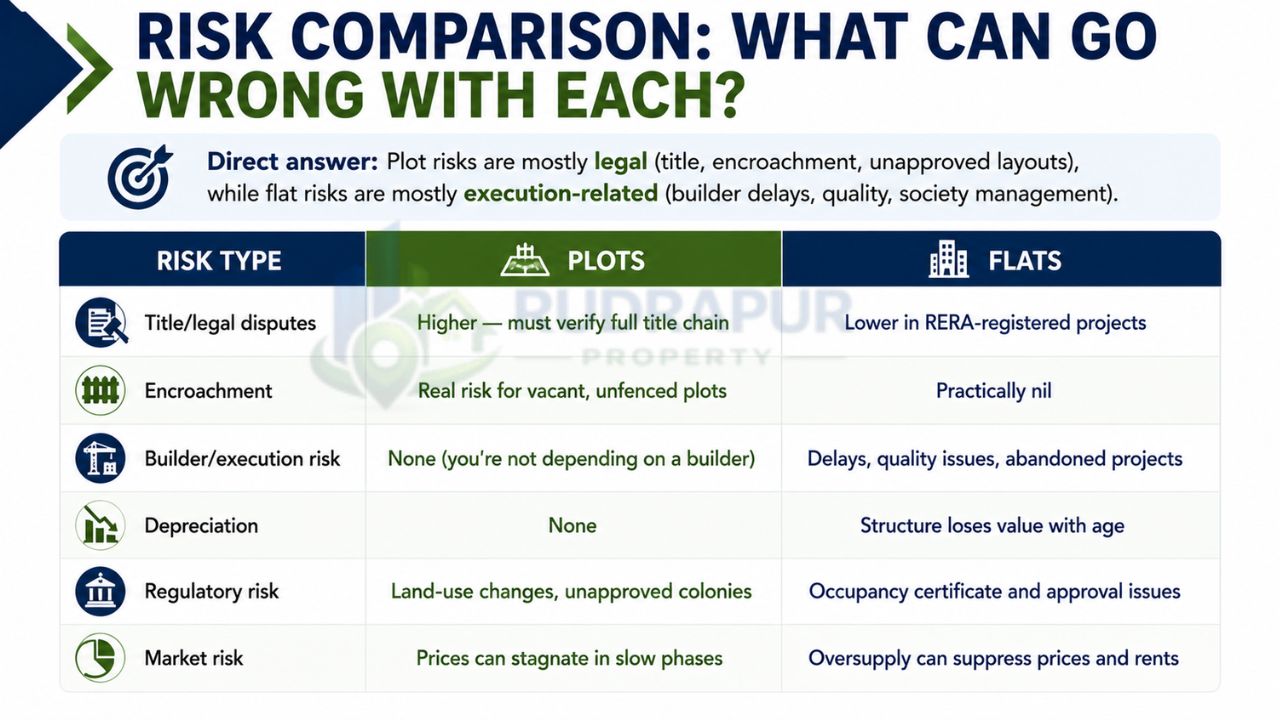
Direct answer: Plot risks are mostly legal (title, encroachment, unapproved layouts), while flat risks are mostly execution-related (builder delays, quality, society management).
| Risk Type | Plots | Flats |
| Title/legal disputes | Higher — must verify full title chain | Lower in RERA-registered projects |
| Encroachment | Real risk for vacant, unfenced plots | Practically nil |
| Builder/execution risk | None (you’re not depending on a builder) | Delays, quality issues, abandoned projects |
| Depreciation | None | Structure loses value with age |
| Regulatory risk | Land-use changes, unapproved colonies | Occupancy certificate and approval issues |
| Market risk | Prices can stagnate in slow phases | Oversupply can suppress prices and rents |
Two practical rules reduce most of this risk:
- For plots: Buy only in approved layouts with clear titles, and complete proper due diligence before paying any advance. Understanding the property registration process in Rudrapur — stamp duty, registry, and mutation — protects you from the most common legal pitfalls.
- For flats: Buy only RERA-registered projects, check the builder’s delivery track record, and prefer ready or near-ready inventory if you are risk-averse.
Maintenance and Holding Costs
Direct answer: Plots cost almost nothing to hold; flats carry recurring monthly costs that eat into net returns.
- Plot holding costs: Property tax (minimal for vacant land in most cases), boundary wall upkeep, and occasional cleaning. Budget a token amount per year.
- Flat holding costs: Society maintenance (often ₹1–3 per sq ft per month), sinking fund contributions, repairs, repainting every few years, and property tax.
Over a 10-year hold, a flat’s cumulative maintenance can quietly consume a meaningful slice of your rental income. Factor this into any plot investment vs flat investment Rudrapur 2026 calculation — gross yield and net yield are different numbers.
Liquidity and Resale: Which Sells Faster?
Direct answer: Popular flats in good societies sell faster in normal markets, but well-located plots attract a broader buyer pool and rarely stay unsold at a fair price.
- Flats: A 2BHK in a known society near SIDCUL has a large, active buyer base — end-users, investors, and employees relocating to Rudrapur. However, older flats (15+ years) become harder to sell as buyers prefer newer inventory.
- Plots: Selling can take longer because plot buyers negotiate harder and do more due diligence. But a clean-title plot in a developing corridor appeals to end-users, builders, and investors alike — and its value proposition improves with age rather than deteriorating.
Liquidity in both cases depends more on pricing realism than asset type. Overpriced properties sit; fairly priced ones move.
Construction Freedom and Future Flexibility
Direct answer: Plots offer complete flexibility — this is their most underrated advantage and something a flat can never match.
With a plot, you can:
- Build a custom home exactly suited to your family’s needs.
- Construct ground + two floors and rent out the upper units, turning your plot into an income asset.
- Add commercial use (shop-front) on plots along developing roads, where permitted.
- Sell part of a larger plot and keep the rest.
- Simply hold and let appreciation compound with zero effort.
A flat is what it is on the day you buy it. You cannot add a floor, change the layout structurally, or convert its use. For buyers who value optionality — especially younger investors whose needs will evolve — this flexibility is a serious point in favour of plots.
Loans and Taxation: The Practical Differences
Direct answer: Flats are easier and cheaper to finance; plots get full loan and tax benefits only if you construct on them within the bank’s and income-tax rules’ timelines.
Key differences every buyer should know:
- Loan-to-value: Home loans on flats commonly cover 80–90% of value. Plot loans typically cover less, at slightly higher interest rates, with shorter tenures.
- Composite loans: If you plan to buy a plot and construct, a composite plot-plus-construction loan gets you home-loan-like terms — but banks usually require construction to begin within 2–3 years.
- Tax benefits: Interest and principal deductions apply to flats from possession. For plots, tax benefits kick in only once construction is complete.
- Stamp duty and registration: Both asset types attract stamp duty and registration charges in Uttarakhand; budget roughly 5–7% of the transaction value depending on buyer category and current rates.
If financing is the deciding factor for you, structured home loan assistance for buyers can help you compare plot loans, composite loans, and standard home loans before you commit.
So, Which Is Better for Investment in Rudrapur — Plots or Flats?
Direct answer: Choose a plot if your goal is long-term wealth creation and you can wait 7–15 years; choose a flat if you want rental income, easy financing, or a home you can use now.
Here is the honest breakdown by buyer type:
1. Long-Term Investors (7–15 year horizon)
Plots win. Rudrapur’s outward expansion favours land. If you can verify title properly, buy in an approved layout in a growth corridor, and hold patiently, plots have historically offered better returns than flats in Rudrapur. India’s tier-2 growth thesis supports this: industry research such as ANAROCK’s reports on tier-2 residential markets repeatedly highlights land-led appreciation in industrial tier-2 cities.
2. Income-Seeking Investors
Flats win. If you want your property to pay you monthly, a 2BHK near SIDCUL or the city centre delivers dependable rent with minimal effort. Plots produce nothing until developed.
3. End-Users Who Need a Home Soon
Flats win — with one exception. If you need housing within a year, buy a ready flat. But if you can wait 2–3 years and want a home built to your taste, a plot plus construction often delivers more space per rupee and a better long-term asset.
4. First-Time Buyers on a Tight Budget
It depends on discipline. A small plot in a developing colony can be the cheapest entry into Rudrapur real estate — but only if you buy a clean title in an approved layout. If due diligence feels overwhelming, a modest flat in a RERA-registered project is the safer first step.
5. NRI and Outstation Investors
Flats are more practical. Vacant plots need local monitoring against encroachment. A flat in a managed society is far easier to own remotely, and it earns rent while you’re away.
The Balanced Bottom Line
Neither asset is universally “better.” The data and on-ground experience in Rudrapur point to a simple framework:
- Plots = higher potential returns, more effort, more patience, more due diligence.
- Flats = moderate returns, immediate utility, monthly income, less effort.
Many seasoned Rudrapur investors actually do both: a flat for rental stability and a plot for long-term appreciation. If your budget only permits one, let your goal — income vs growth — make the decision, not market noise.
Whatever you choose, insist on clear titles, approved layouts or RERA registration, realistic pricing backed by proper valuation, and complete registration formalities. That discipline matters more to your final returns than the plot-vs-flat choice itself.
5. FAQ Section
1. Which gives better returns in Rudrapur — plots or flats?
Plots in developing corridors have historically given better capital appreciation (often 8–15% annually in good pockets), while flats deliver moderate appreciation plus 2.5–3.5% rental yield. For pure long-term returns, plots usually win; for total convenience and income, flats win.
2. Is it safe to buy a plot in Rudrapur?
Yes, provided you verify the title chain, buy in an approved layout, confirm land-use classification, and complete proper registration. Most plot-related losses come from skipping due diligence, not from the market itself. A professional survey and legal verification before payment is strongly recommended.
3. What is the average rental yield on flats in Rudrapur?
Gross rental yields typically range between 2.5% and 3.5% per year. A 2BHK near SIDCUL or the city centre sits at the healthier end of this range because of steady demand from industrial employees and professionals.
4. Can I get a home loan for buying a plot in Rudrapur?
Yes, but terms differ from flat loans. Plot loans usually have lower loan-to-value ratios, slightly higher interest rates, and shorter tenures. A composite plot-plus-construction loan offers better terms if you commit to building within the bank’s timeline, usually 2–3 years.
5. Which areas in Rudrapur are best for plot investment?
Growth corridors such as Kichha Road, Lalpur, Bilaspur Road, and approved colonies near the SIDCUL belt have shown strong appreciation. Prioritise approved layouts with clear titles over marginally cheaper unapproved options — approval status matters more than a small price difference.
6. Are flats in Rudrapur a good investment in 2026?
Yes, for income-focused buyers and end-users. Rudrapur’s industrial workforce keeps rental demand steady, and RERA-registered ready flats carry relatively low risk. Expect moderate appreciation rather than dramatic gains, and factor monthly maintenance into your return calculations.
7. Do plots have any tax benefits like flats?
Not while vacant. Home-loan tax deductions under Sections 80C and 24(b) apply to plots only after you construct a house on them. Flats offer these benefits from possession, which makes them more tax-efficient for salaried buyers with home loans.
8. What documents should I check before buying a plot or flat in Rudrapur?
For plots: title deed and chain documents, approved layout plan, land-use certificate, encumbrance status, and mutation records. For flats: RERA registration, approved building plan, occupancy certificate (for ready units), builder-buyer agreement, and society formation documents. Registration must be completed at the sub-registrar’s office in both cases.