
The Rudrapur Ring Road is a 20.5-km, four-lane bypass built at a cost of roughly ₹1,100 crore by the National Highways Authority of India (NHAI). It loops around the outer edge of the city, connecting around 12 villages, linking NH-74 near Shimla Pistaur and Malsa on one side, extending toward Temri village (Uttar Pradesh) on the other, and rejoining NH-87 after passing Bhagwanpur and Chhatarpur. As of mid-2026, the road is largely complete and carrying vehicles on several stretches, with formal inauguration pending. Areas expected to benefit the most are those close to SIDCUL, Kashipur Road, Chhatarpur, Bhagwanpur, and the Kichha–Haldwani corridor, thanks to better industrial access and reduced city-centre congestion.
If you’re tracking where to buy property in Rudrapur in 2026, this ring road is the single biggest infrastructure story shaping the city’s real estate map. Here’s a detailed, area-by-area breakdown.
What Is the Rudrapur Ring Road Project?
Rudrapur is Uttarakhand’s largest industrial town, anchored by the SIDCUL (State Industrial Development Corporation of Uttarakhand Limited) industrial estate, home to manufacturing units of companies such as Bajaj, Tata Motors, Dell, Nestlé, Britannia, and HP. This industrial base has driven years of employment-led migration and steady real estate demand — but it also created a serious traffic problem, with heavy vehicles heading to SIDCUL forced to squeeze through the city core.
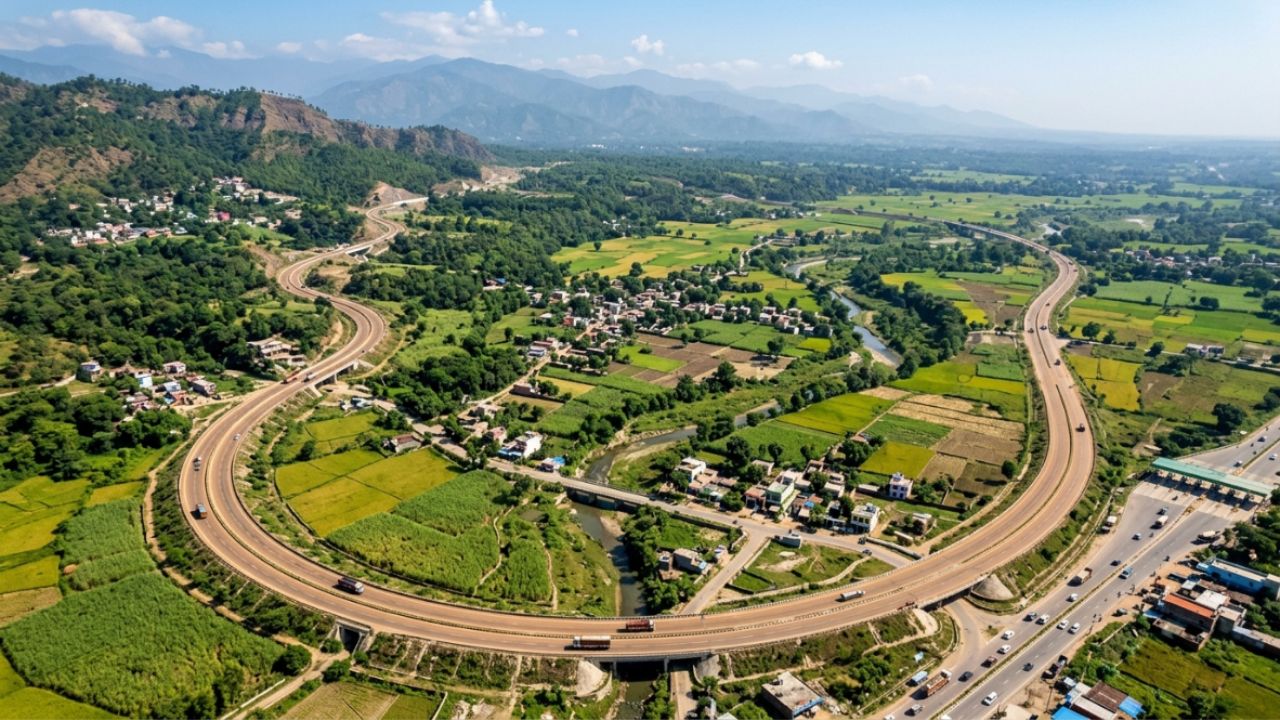
The Ring Road project was conceived to solve exactly this. Key facts:
- Length: Approximately 20.5 km (some official communications round this to 21–21.3 km).
- Design: Four-lane, access-controlled bypass road.
- Cost: Around ₹1,100 crore (also reported as ₹1,092 crore), funded and executed under NHAI.
- Purpose: Divert SIDCUL-bound heavy and industrial traffic away from the city centre, and give Rudrapur an outer growth corridor similar to what larger cities in Uttar Pradesh and Uttarakhand have built.
- Structures: The alignment includes roughly 20 locations with overbridges, underpasses, and vehicle overpasses (VOPs) — including one near SIDCUL — to keep local traffic moving freely at major crossings.
The project has a long history. It was first proposed by the state Public Works Department (PWD) years ago as a longer, roughly 35-km stretch, but stalled when funds for the required physical survey weren’t released. NHAI later took over, redesigned the alignment to its current ~20.5–21.3 km form, and construction proceeded under monitoring from Chief Minister Pushkar Singh Dhami’s government, with local MLA Shiv Arora and district officials tracking progress on the ground.
Rudrapur Ring Road Route Map — Full Alignment Explained
The ring road runs along the outer periphery of Rudrapur, deliberately routed to avoid the congested inner city while still touching the key growth corridors that feed into it. Based on the finalised NHAI alignment, here is how the route is described:
- Starting point near NH-74: The road links National Highway-74 close to Shimla Pistaur and Malsa villages, on the outskirts of the city.
- Extension toward Uttar Pradesh border: From there, the alignment extends toward Temri village, just across the Uttarakhand–Uttar Pradesh boundary — reflecting how closely Rudrapur’s industrial catchment area overlaps with neighbouring UP districts.
- Re-crossing NH-74 within Rudrapur: The road loops back and crosses NH-74 a second time within the municipal limits, keeping the alignment close enough to the city to serve local traffic without cutting through it.
- Onward through Bhagwanpur and Chhatarpur: The route then continues through the Bhagwanpur and Chhatarpur localities — both areas that are already seeing new residential plotting activity.
- Joining NH-87: The ring road finally connects into National Highway-87, completing the loop and giving the city a continuous outer bypass connecting its major highway approaches.
Along the way, the alignment touches or runs close to around 12 villages on Rudrapur’s outskirts, and passes near the SIDCUL industrial belt, which was the primary reason the project was prioritised.
Why This Alignment Matters
Unlike a simple bypass that just skirts one side of a town, a true ring road connects all the major highway approaches — in Rudrapur’s case, NH-74 (which carries Delhi–Nainital corridor traffic) and NH-87 (which connects toward Pilibhit and the wider Rohilkhand region). That means vehicles travelling between Delhi and Nainital, or trucks moving to and from SIDCUL, no longer need to enter the congested city core at all — a change local traders and residents had been asking for since 2020.
Current Status of Rudrapur Ring Road (2026 Update)
The project has moved quickly through its final stages in 2026. Here’s the timeline as publicly reported:
| Period | Status |
| 2020 | Ring road first raised as a long-pending demand from Rudrapur residents and traders amid worsening SIDCUL-linked traffic congestion. |
| 2022 | State PWD prepares the initial project blueprint; a longer ~35 km alignment is proposed but stalls over survey funding. |
| Later phase | NHAI takes over the project, finalises a shorter, focused ~20.5–21.3 km alignment along the city’s outer areas, and construction begins. |
| March 2026 | Project reaches roughly 95% completion; authorities plan a trial run after March 20, 2026. |
| Early April 2026 | Construction largely complete; vehicle movement begins on several stretches, while a few sections remain closed for finishing work (such as road-marking and painting) near SIDCUL. Formal public inauguration is awaited. |
| April 2026 | Reports put completion at around 98%, with full operational status expected by May 2026. |
| Mid-2026 | Road is functionally usable across most of its length; heavy-vehicle diversion from the city core is expected to become the norm once inauguration and full commissioning are complete. |
Practical takeaway for buyers: the ring road is no longer a “someday” project — it is a near-complete, largely functioning piece of infrastructure. That distinction matters for real estate decisions, because the market impact of a ring road typically front-runs its formal opening, and Rudrapur is already in that window.
Which Areas Will Benefit Most From the Ring Road?
Not every part of Rudrapur gains equally from a ring road. Localities close to an interchange, junction, or VOP — especially those already positioned along an active growth corridor — tend to see the sharpest gains in accessibility and, over time, in demand. Based on the confirmed alignment, here’s how key areas stack up.
| Area | Proximity to Ring Road | Primary Benefit | Best Suited For |
| SIDCUL & SIDCUL Road | Ring road passes directly alongside, with a dedicated vehicle overpass (VOP) | Faster, restriction-free movement of goods and industrial traffic; reduced dependence on time-bound city entry rules for heavy vehicles | Rental housing, warehousing, industrial-linked commercial use |
| Kashipur Road | Feeds into the ring road’s southern alignment | Improved connectivity to both the city and NH-74/NH-87 without the old bottlenecks | Affordable plots, first-time buyers, mid-income housing |
| Chhatarpur | Directly on the ring road route | Direct frontage/proximity to the new corridor; early-mover advantage for plotted development | Residential plots, gated colonies |
| Bhagwanpur | Directly on the ring road route | Similar early-corridor advantage as Chhatarpur; growing plot activity | Residential land, long-term appreciation plays |
| Shimla Pistaur & Malsa | At the ring road’s NH-74 tie-in point | Improved highway access at the point where the loop begins | Land banking, longer-horizon investment |
| Nainital Road | Indirect — benefits from reduced through-traffic in the city core | Less congestion on the existing corridor once heavy vehicles shift to the ring road | End-use family homes, established buyers |
| Awas Vikas Colony | Indirect | Quieter, less congested access roads as city-core traffic eases | Middle-class family housing |
| Pantnagar / Airport Road belt | Connects via NH-87 tie-in | Better linkage between the airport corridor and the industrial belt | Long-term institutional and commercial interest |
| Kichha–Haldwani corridor | Benefits from reduced Rudrapur city-centre bottleneck on Delhi–Nainital traffic | Faster through-travel for commuters and tourists heading toward Haldwani/Nainital | Commuter housing, transit-linked development |
In short: areas that sit directly on the alignment (Chhatarpur, Bhagwanpur, the SIDCUL belt) get the most immediate, direct benefit, while corridor areas like Kashipur Road and Nainital Road benefit indirectly through decongestion and improved access to the new outer loop.
Impact on Property Prices and Rental Yields
Ring roads across India follow a fairly consistent pattern: values along and near the alignment tend to move ahead of the general market once construction visibly nears completion, and rental demand strengthens wherever the road improves commute times to a major employment hub — in Rudrapur’s case, SIDCUL.
A few points worth understanding before you read too much into any single number:
- Plot prices in Rudrapur currently span a wide range — broadly from around ₹9,000 to ₹55,000 per square yard depending on locality, with outer growth corridors like Kashipur Road at the affordable end and established, amenity-rich sectors (Awas Vikas, Nainital Road) at the higher end.
- SIDCUL-adjacent localities typically see the strongest rental demand in the city, since a large share of tenants are working professionals employed in nearby factories and offices. A ring road that eases goods and staff movement around this belt generally reinforces — rather than changes — this rental strength.
- Land directly on or very near the new alignment (Chhatarpur, Bhagwanpur, the NH-74 tie-in villages) is the segment most likely to re-rate as the road becomes fully operational, simply because “frontage on a new four-lane corridor” is a concrete, visible upgrade that buyers and developers respond to quickly.
- Corridor areas that gain from decongestion rather than direct frontage (Nainital Road, Awas Vikas, established Kashipur Road pockets) tend to see a steadier, more end-use-driven demand pattern rather than a sharp price spike.
Treat any specific appreciation percentage you hear from a broker with caution — infrastructure-linked price movement in Tier-2/Tier-3 Indian cities is real but uneven, and depends heavily on the specific plot’s actual distance from an interchange or VOP, not just the general area name. Always verify current asking rates for the exact street or society you’re considering, ideally against at least two to three recent, comparable transactions.
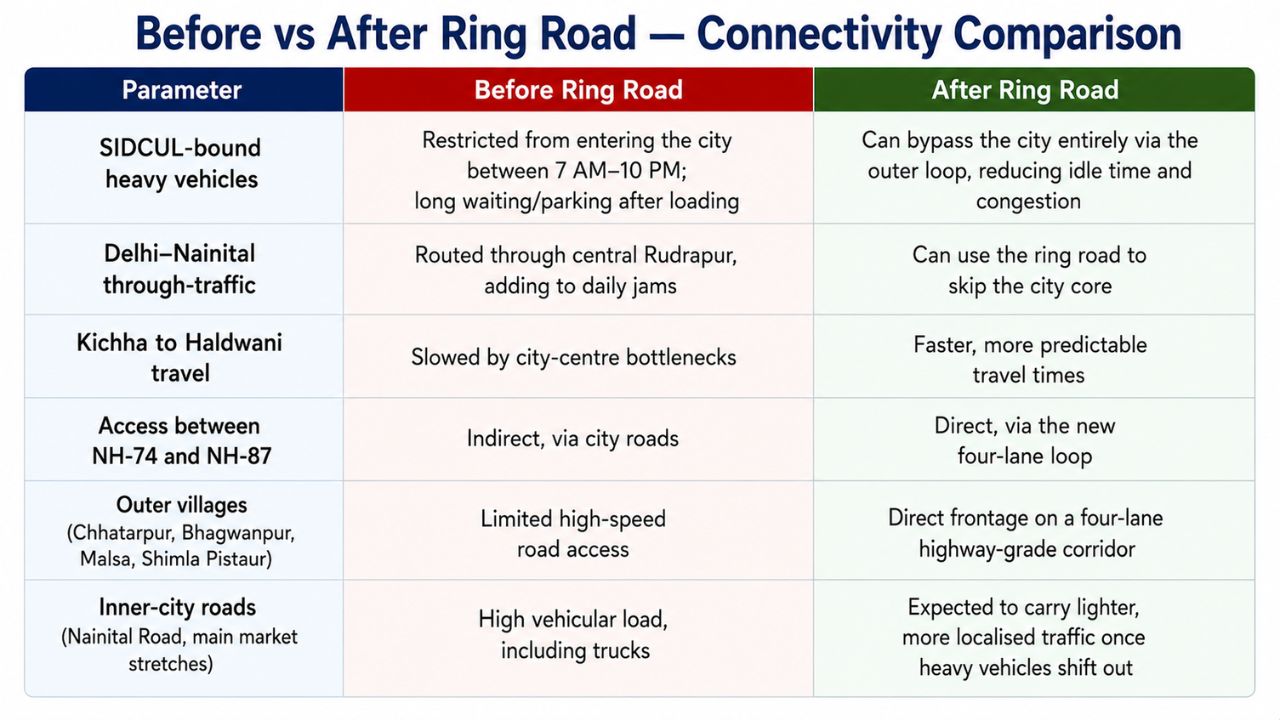
Before vs After Ring Road — Connectivity Comparison
| Parameter | Before Ring Road | After Ring Road |
| SIDCUL-bound heavy vehicles | Restricted from entering the city between 7 AM–10 PM; long waiting/parking after loading | Can bypass the city entirely via the outer loop, reducing idle time and congestion |
| Delhi–Nainital through-traffic | Routed through central Rudrapur, adding to daily jams | Can use the ring road to skip the city core |
| Kichha to Haldwani travel | Slowed by city-centre bottlenecks | Faster, more predictable travel times |
| Access between NH-74 and NH-87 | Indirect, via city roads | Direct, via the new four-lane loop |
| Outer villages (Chhatarpur, Bhagwanpur, Malsa, Shimla Pistaur) | Limited high-speed road access | Direct frontage on a four-lane highway-grade corridor |
| Inner-city roads (Nainital Road, main market stretches) | High vehicular load, including trucks | Expected to carry lighter, more localised traffic once heavy vehicles shift out |
Best Areas to Buy Property After the Ring Road
Based on the alignment and the benefit analysis above, here’s how to think about your options depending on what you’re optimising for:
- For rental income tied to SIDCUL employment: Look at housing close to SIDCUL Road and the SIDCUL VOP — this segment has the most consistent tenant demand in the city.
- For affordable entry with upside: Kashipur Road remains one of the more reasonably priced corridors with genuine connectivity gains from the ring road.
- For land appreciation on a longer horizon: Chhatarpur and Bhagwanpur, being directly on the alignment, are worth evaluating for plotted development, provided titles and land-use approvals are clean.
- For end-use family living with established infrastructure: Nainital Road and Awas Vikas Colony offer schools, markets, and social infrastructure already in place, with the added benefit of reduced through-traffic once the ring road is fully commissioned.
- For a balance of affordability and future road access: The stretch near Gadarpur and the Sitarganj–Kichha highway corridor is worth watching as the ring road matures and secondary roads improve to feed into it.
Investment Advice for Buyers
A few practical, non-speculative points to keep in mind:
- Verify exact distance from an interchange or VOP, not just the general locality name — “on Kashipur Road” can mean anywhere from a few hundred metres to several kilometres from the actual ring road alignment.
- Check land-use classification and 143 conversion status before buying agricultural land near the corridor, especially in outer villages like Chhatarpur, Bhagwanpur, Malsa, or Shimla Pistaur, since converting agricultural land for residential/commercial use involves a separate approval process.
- Confirm RERA registration for any organised residential project, and cross-check developer track record independently.
- Understand Uttarakhand’s land-purchase rules for outsiders. Non-residents of Uttarakhand can generally purchase agricultural/vacant land only up to 250 square metres (about 2,690 sq. ft.) without special permission; buying beyond that limit requires District Magistrate approval, and the intended purpose (residential, commercial, industrial, etc.) affects whether approval is granted.
- Budget for stamp duty and registration charges, which in Uttarakhand are calculated on the higher of the declared sale value or the government circle rate, with registration charges generally capped around 1–2% of the transaction value (subject to a maximum limit) and stamp duty rates that can vary by buyer gender and ownership structure. Circle rates differ by district and locality, so always confirm the current rate for the specific plot before finalising your budget.
- Don’t buy purely on ring-road proximity. Water supply, road width, drainage, and flood risk (for plots near seasonal water channels) matter just as much for long-term liveability and resale value as highway frontage does.
Pros and Cons of Buying Property Near the Proposed Route
| Pros | Cons |
| Direct frontage on a new four-lane corridor once fully commissioned | Some stretches may see higher traffic noise and dust during the final commissioning phase |
| Faster access to SIDCUL, NH-74, and NH-87 | Land-use conversion (agricultural to residential/commercial) can add time and cost for outer-village plots |
| Strong long-term potential for outer villages currently priced lower than the city core | Heavy-vehicle traffic on the ring road itself may make immediate roadside plots less desirable for quiet residential use |
| Reduced congestion benefits even for areas not directly on the alignment (Nainital Road, city core) | Non-resident buyers face the 250 sq. m. purchase cap without DM approval, which can slow larger acquisitions |
| Rising developer interest typically follows major road infrastructure, improving future resale liquidity | Infrastructure-linked price gains are uneven — not every plot near the “ring road area” benefits equally |
Potential Challenges and Risks for Nearby Properties
- Uneven benefit distribution: Being in the same village or ward as the ring road doesn’t guarantee proximity to an actual junction or VOP — due diligence on exact distance matters.
- Land-title and conversion delays: Outer-village land often carries agricultural classification; converting it for residential/commercial use takes time and isn’t guaranteed.
- Traffic and safety near the highway edge: Plots with direct frontage on a high-speed four-lane road may need additional setback, boundary walls, or noise mitigation for residential comfort.
- Speculative pricing: As with any infrastructure-linked market, some sellers price in “future ring road benefit” well ahead of actual commissioning — always compare asking prices against genuinely recent, comparable transactions rather than listing prices alone.
- Regulatory caps for outsiders: Buyers from outside Uttarakhand should factor in the 250 sq. m. purchase limit and DM-approval process into their timeline before committing to a larger plot.
5. FAQ Section
Q1. What is the total length of the Rudrapur Ring Road? The Rudrapur Ring Road is approximately 20.5 km long (reported by some sources as up to 21.3 km), built as a four-lane, access-controlled bypass around the outer edge of the city.
Q2. Who is building the Rudrapur Ring Road, and what is its cost? The project is being executed by the National Highways Authority of India (NHAI), at an estimated cost of around ₹1,100 crore.
Q3. Which villages and highways does the Rudrapur Ring Road connect? The alignment connects roughly 12 outer villages, links NH-74 near Shimla Pistaur and Malsa, extends toward Temri village on the Uttar Pradesh border, re-crosses NH-74 within Rudrapur, passes through Bhagwanpur and Chhatarpur, and finally joins NH-87.
Q4. Is the Rudrapur Ring Road open to traffic in 2026? As of mid-2026, the road is substantially complete, with vehicle movement already underway on several stretches. A few sections were still undergoing finishing work such as road-marking, and formal public inauguration was pending as of the latest available reports — so it’s worth checking current status locally before finalising travel or investment plans.
Q5. Which areas benefit the most from the Rudrapur Ring Road? Localities directly on the alignment — SIDCUL, Chhatarpur, Bhagwanpur, and the Shimla Pistaur/Malsa stretch — see the most direct benefit, while corridor areas like Kashipur Road and Nainital Road benefit indirectly through reduced city-centre congestion.
Q6. Will the ring road increase property prices in Rudrapur? Infrastructure like a ring road generally supports property demand and, over time, values in directly connected areas, particularly land with genuine frontage or proximity to an interchange. However, the extent of any price increase varies significantly by exact location, so it shouldn’t be assumed uniformly across the whole city.
Q7. Can outsiders (non-residents of Uttarakhand) buy land near the Rudrapur Ring Road? Yes, but with a restriction: non-residents can generally purchase up to 250 square metres of land without special permission. Buying beyond this limit requires approval from the District Magistrate, and approval depends on the stated purpose of the land.
Q8. What are the stamp duty and registration charges for property in Rudrapur? Stamp duty in Uttarakhand is calculated on the higher of the declared sale value or the government circle rate for that locality, and varies by buyer gender and ownership structure; registration charges are generally capped around 1–2% of the transaction value. Always confirm the current circle rate and exact charges for your specific plot before budgeting.
Q9. How does the ring road help SIDCUL industrial traffic specifically? Currently, heavy vehicles heading to SIDCUL are restricted from entering the city between 7 AM and 10 PM, forcing long waits after loading. The ring road, with a dedicated vehicle overpass near SIDCUL, is designed to let these vehicles bypass the city entirely.
Q10. Is Chhatarpur or Kashipur Road a better investment after the ring road? Chhatarpur sits directly on the ring road alignment, which suits buyers looking for longer-horizon appreciation on plotted land. Kashipur Road offers a more affordable, already-established corridor with steadier end-use demand. The right choice depends on your budget, timeline, and whether you’re buying for end-use or long-term investment — it’s worth discussing your specific goals with a local advisor before deciding.
Thinking about buying property near the Rudrapur Ring Road? Whether you’re eyeing a plot in Chhatarpur, a flat on Kashipur Road, or rental-ready housing near SIDCUL, Rudrapur Property can help you evaluate the right location for your budget and goals.
📞 Call us now: +91 70601 50855